
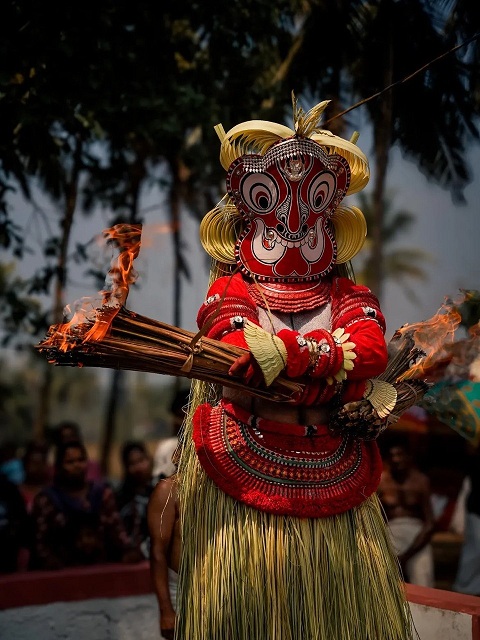
Yasin Asharaf P & Ranjith Parakkadan | Published on 06/10/2026
It was a warm evening in Kannur when we stopped our vehicle for a cup of tea at an old roadside tea shop. The evening was slowly settling over the landscape. Across the narrow road stood a mosque, and worshippers were beginning to walk out after the evening Asr prayer. The sound of conversations and the quiet rhythm of the village evening filled the air.
We were on our way to Neeliyar Kottam, where a Theyyam performance was scheduled to begin after 5 in the evening and continue until sunset. We had just passed the Kannur University campus when the landscape began to change. The roads grew quieter, the greenery thicker, and soon we entered what appeared to be a small forest.
There was no grand temple waiting for us.
Instead, a dense grove welcomed us - a quiet patch of trees, almost like a forest preserved within the settlement. At its centre was an open ground where the Theyyam would be performed. There were no towering walls, elaborate gateways or magnificent temple structures. The trees themselves seemed to form the walls of the sacred space.
People had already begun arriving from different places. Some had come simply to witness the ritual. Others had come with prayers, questions and hopes they wished to place before the deity.
I was accompanying two faculty members from Gujarat, and our curiosity grew with every step. Where almost every element seems to carry a story—and at the heart of it is the powerful story of Neeli.
According to legend, in Kottiyoor, Kannur, there once lived a woman named Neeli, remembered for her beauty, intelligence and strength. She belonged to a lower-caste community and was killed by the local ruler.
Neeli returned not as a victim, but as a powerful divine presence. After her death, she came to be worshipped as Neeliyar Bhagavathi. What began as the story of a woman who suffered injustice thus became the story of a Goddess—her memory transformed into worship, ritual and sacred tradition at Neeliyar Kottam.
We were not taken directly to the performance ground. Instead, we were led towards a small hut hidden within the grove. This was where the Theyyam was being born.
Inside, a young man sat on the floor, wearing nothing more than a mundu. His transformation had already begun. Much of the intricate face painting was complete. Lines, colours and patterns covered his face, made largely from natural materials. What we were witnessing was not simply the preparation of a performer for a show. It was the preparation of a human being to become something beyond himself.
The more closely we watched, the more remarkable it became.
The colours, the ornaments, the costumes and the ritual objects were deeply connected with nature. Nothing seemed accidental. Every element had its place, its meaning and its own story. Nearby lay an enormous headgear, almost four times the height of the performer himself. Crafted from bamboo and other materials gathered from nature, it was both striking and imposing. At first glance, it seemed almost impossible to lift, let alone wear. Yet, this towering structure was an essential part of the transformation—the final element that would help turn the young man into the deity of Neeliyar Kottam.
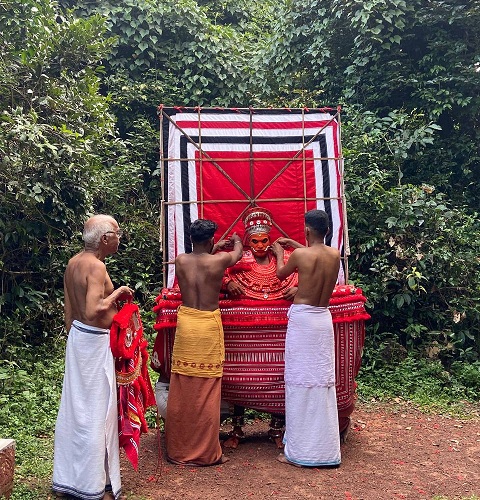
Interestingly, most of the people involved in the preparations were young. Young hands were carefully arranging the costumes and ornaments, passing objects to one another and helping the performer through each stage. An elderly man stood nearby, quietly observing everything and offering instructions and precautions.
At one point, one of the men gently tapped the towering headgear. It was not an ordinary gesture. He was checking for anything living that might have taken shelter inside it before it was placed on the performer.
When the preparations inside the hut were complete, the performer stepped outside. The transformation continued. One by one, the layers of costume, ornaments and sacred accessories were carefully placed on him. Young people worked together to help him wear the elaborate attire, including the enormous headgear. It took time. Every piece had to be positioned correctly.
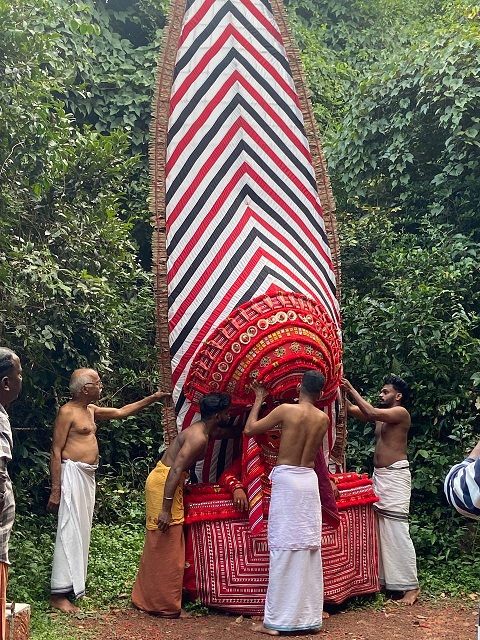
- Neeliyar Kottam is in preparation.
And then, finally, he was ready. A few moments earlier, we had been looking at a young man sitting on the floor of a small hut. Now, standing before us, was someone entirely different.
He began walking through a narrow pathway in a thick grove. People stood on either side, making way for him. The path was so narrow that the enormous headgear seemed to brush against the surrounding greenery as he moved forward.
Slowly, the procession reached the open ground at the heart of the grove.
People had gathered around it. The drums began. And something changed.
The young man disappeared. Neeliyar Kottam had arrived.
With the rhythm of the drums and the chants and songs accompanying the ritual, the performer was no longer merely representing a deity. Within the ritual space, he was understood as the deity itself. This is perhaps one of the most powerful aspects of Theyyam.
It is not simply a performance where a human being acts like a god. For those gathered around, the boundary between performer and deity becomes almost invisible.
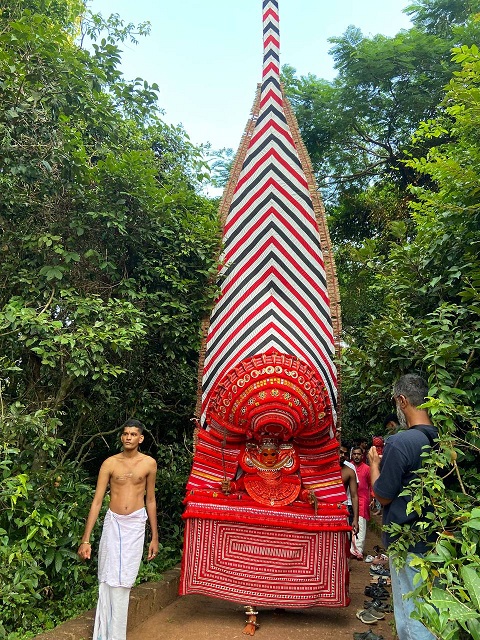
- Neeliyar Kottam Theyyam
The people who had offered the Theyyam came forward first. They stood before the deity, received blessings and began speaking. They spoke about their lives. Their worries. Their hopes. Their unanswered questions. And the deity responded.
This communication became the heart of the ritual. A young couple stepped forward with a question that had perhaps been carried in their hearts for a long time—their hope for a child. Others had come with different concerns: a family hoping to build a house, someone worried about a livelihood, another seeking protection for their family, each carrying a private question into the presence of the Theyyam.
One by one, they approached. They spoke. They waited.
Then the Theyyam began to speak to the couple.
The voice was not the voice of a man giving advice. It was loud, commanding and deliberate—the voice of a deity addressing those who had come before it.
“Why have you come so late?”
The question fell heavily into the silence.
“I have been here all this time. But where were you? You went to the doctors. You went to the hospital. You sought answers everywhere else. You had no time to come here. And now, when you desire a child, you have come to me. Now you need me.”
There was silence again.
The people standing around listened without interruption. The couple stood before the Theyyam, waiting for what would come next.
Then the voice rose again.
“I will give you a child. But tell me—what will you offer me?”
For a moment, the man seemed unable to answer.
Theyyam continued.
“When the child is born, you must bring the child here. And I will give the child the first sweet.”
The words were both a blessing and an instruction. The sacred encounter was not ending with the fulfilment of a request; it was creating an obligation that would continue beyond the ritual, into the life of the family.
Then the Theyyam asked once more, its voice echoing across the grove:
“You will bring the child here?”
The man finally answered.
“Yes.”
And with that single word, the conversation came to an end.
What stayed with me was not merely the promise of a child. It was the extraordinary seriousness of the exchange. The people gathered there did not appear to be watching a performance. They were listening to their God.
For them, the Theyyam was not simply a performer wearing an elaborate costume. In that sacred moment, the deity had appeared before them, heard their concerns, questioned them, answered them, and placed a responsibility upon them. Sometimes the answers were direct. Sometimes they came in the form of advice, reassurance or interpretation. The interaction between the deity and the devotees revealed something much deeper than a ritual performance.
Theyyam was functioning as a space where people could speak.
A space where their personal anxieties could be expressed. A space where they could seek guidance.
As the evening progressed, more people came forward. They received blessings, spoke their wishes and offered donations. The ritual continued, surrounded by the ancient trees of the grove and the steady rhythm of the drums. But Theyyam has its own clock. It belongs to the rhythm of nature. The performance continued only until sunset.
As the sun began to disappear beyond the horizon, the ritual slowly approached its conclusion. The deity began preparing to leave. The same narrow pathway through which Neeliyar Kottam had arrived now became the path of return.
We followed from a distance. The light was fading. The trees were becoming darker.
And then, through the thick grove, another sound reached us—the Maghrib Azan. It travelled softly through the evening air from the mosque, announcing another prayer as the sun prepared to set. Just moments earlier, the grove had been filled with the rhythm of the Theyyam drums. Now, another sacred sound was rising into the same evening sky.
Perhaps this is what makes the experience so deeply moving. Theyyam belongs to the people who come with their questions, their fears, their hopes and their faith. And it opens its doors to everyone. There are no boundaries of caste, religion, social status or economic standing before the deity. In the presence of Theyyam, these divisions seem to disappear. The rich and the poor, people of different communities and beliefs, all stand together with the same human vulnerabilities and hopes.
The World of Theyyam
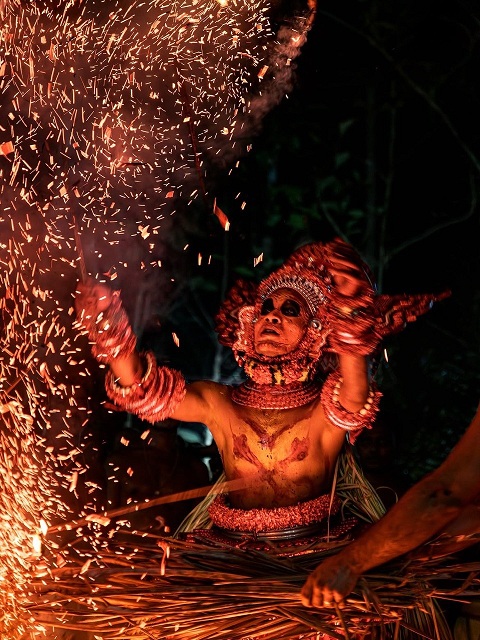
From the end of October, as the monsoon slowly withdraws and the evenings begin to carry a different stillness, the sacred groves of North Malabar start preparing for the Theyyam season. Until May, Kannur, Kasaragod, Wayanad and the northern parts of Kozhikode become a landscape of rituals, drums, fire and colour. In the middle of villages, behind houses, beside ponds and beneath old trees, the kaavu begins to awaken.
(Image Credit: Madras Photo Blog)
More than 400 distinct forms of Theyyam are known across Northern Kerala, with nearly a 1000 performances taking place across the region and around a lack of people attending the ritual each year. Yet no two Theyyams are quite the same. Each has its own story, distinctive appearance, movements, songs and rituals, carrying a unique identity shaped by the community and sacred tradition to which it belongs. ‘Muchilottu Bhagavathi’ appears with her own magnificence. ‘Gulikan’ carries a different presence. ‘Pottan Theyyam’ speaks through another set of stories. ‘Raktha Chamundi’, ‘Kari Chamundi’ and ‘Wayanadu Kulaven’ each have their own character and power.
There are also stories that remind us that the cultural world of North Malabar has never existed within rigid boundaries. Alongside ancestral figures and Hindu deities are Theyyams associated with Muslim characters, including ‘Bappiriyan’, ‘Ummachi’ and ‘Aalibhootham’. They belong to a landscape where communities have lived beside one another for generations, sharing stories, spaces and memories.
But before the Theyyam appears before the devotees, a series of important rituals takes place behind the scenes.
(Image Credit: Madras Photo Blog)
For weeks, sometimes months, the person who will become Theyyam follows Vrutham—a period of discipline and preparation. Fasting, prayer, meditation, ritual observances and restrictions become part of everyday life. The performer gradually withdraws from the ordinary rhythm of life and prepares to enter another state of being.
Then comes the transformation.
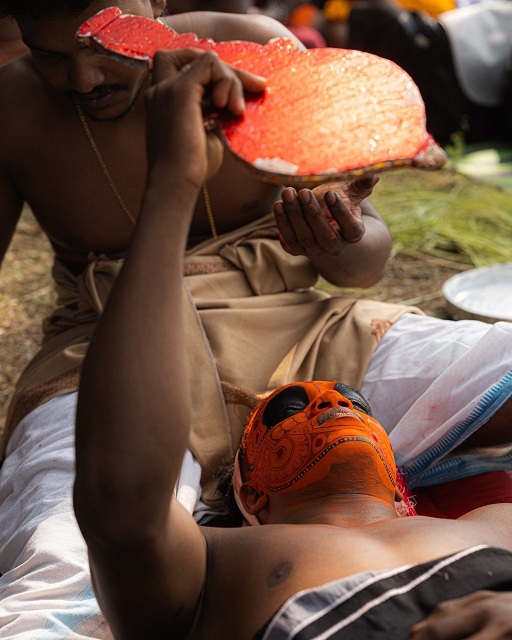
The face that we know begins to disappear beneath layers of colour. Every line has its place. Every pattern belongs to the particular Theyyam being created. Turmeric, lime and other natural things become colours. A simple brush can be made from the rind of a coconut. Around the body, coconut fronds, areca leaves, bamboo slivers, fabrics, garlands and ornaments are carefully assembled.
And above everything rises the Mudi.
(Image Credit: Madras Photo Blog)
The headgear is not simply a crown added to the costume. It is one of the most powerful elements through which the performer takes on the identity of the Theyyam. Its size, shape and construction differ according to the particular deity. Hours of work may go into creating it, often using materials that come directly from the landscape around the sacred grove.
Slowly, the ordinary person disappears.
The face, the body, the costume, the movement, all changes. And then the drums begin to rise.
As the ritual progresses, something changes in the way the people gathered around the kaavu look at him. The performer is no longer simply performing a character. For those who have come to seek the Daivam, the deity has arrived.
This is at the heart of the Theyyam tradition of North Malabar.
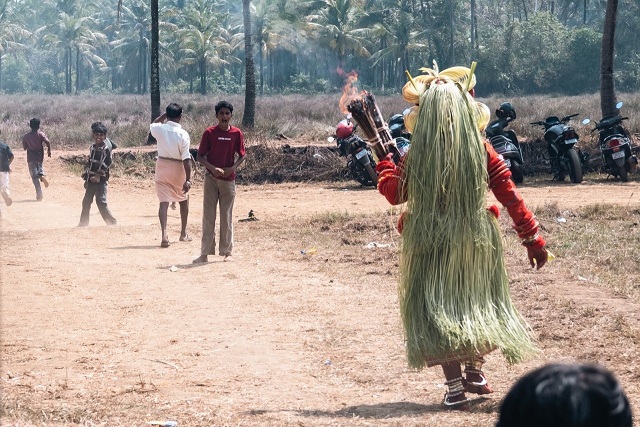
For many devotees, God is not imagined as something distant, beyond the reach of ordinary people. The Daivam comes to them. It listens to their worries. It receives their prayers. It hears their questions. It blesses them. It protects their families, their fields and their communities.
The Theyyam therefore does not remain on a stage to be watched.
People approach it. They stand before it with their hopes, fears and questions. Some come to offer prayers. Some come to seek an answer.
(Image Credit: Madras Photo Blog)
And in that moment, something else happens.
The social order of everyday life seems to fade into the background. A Brahmin, a Nambiar, a Thiyya, a Malayan, a Pulayan, a Vannan, and people from different castes, communities and religions may all stand before the same Theyyam. Before the Theyyam, they stand not as members of one caste or religion, but simply as human beings seeking an answer, a blessing or a moment of reassurance.
An Ancient Folk Ritual and the Gods of Historically ‘Lower’ Caste Communities
In the sacred groves of North Malabar, the story of Theyyam is also the story of people—their suffering, their struggles, their memories, and their resistance.
In the story of Neeliyar Kottam itself, a woman who suffered injustice and was killed by a local ruler was transformed, through the collective memory and faith of the people, into a deity. The person who had once been powerless became divine. The victim became a god. Her story survived not in royal chronicles, but in ritual, performance and the memories of ordinary people.
This is one of the remarkable features of Theyyam. Many of its deities are remembered as human beings who lived, suffered and died. Some are said to have challenged powerful people, questioned social injustice or broken accepted rules, and they were elevated into gods.
Theyyam carries within it layers of traditions that existed long before the religious landscape of present-day Kerala took its current form. Its roots are deeply connected with ancient tribal, animistic and ancestor-worship traditions. Nature, animals, forests, sacred groves and the spirits of ancestors all found a place within this evolving ritual world.
As Bridget and Raymond Allchin write in The Birth of Indian Civilization, “a very large part of this modern folk religion is extremely ancient,” preserving traits that can be traced to the earliest periods of Neolithic and Chalcolithic settlement and expansion.
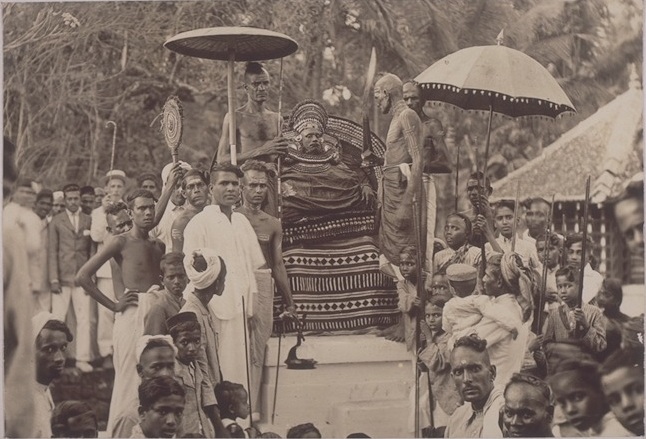
- An archival image of Theyyam
The Mother Goddess occupies a particularly important place in this ancient world. A large number of Theyyam forms are manifestations of female deities, reflecting traditions of fertility, protection and the power of the mother. Similar forms of Mother Goddess worship are also associated with some of the earliest civilizations of the Indian subcontinent, including the Indus Valley Civilization.
But Theyyam was never a single tradition created at one particular moment. It grew over centuries.
Ancestor worship, hero worship, nature worship, village deities and local legends gradually flowed into the ritual. Stories of ordinary men and women became sacred stories. Even the performance itself carries traces of this long history.
The communities traditionally entrusted with performing Theyyam included the Malayar, Vannan and Velan, among others. The Velan is mentioned in Sangam literature, and the ancient Velan Veriyattu, associated with the worship of Murukan, is often discussed in relation to the deeper history of Theyyattam. Over generations, different forms of ritual, music, dance and worship appear to have come together to create what we now recognize as Theyyam.
The tradition did not remain unchanged. Over centuries, it evolved, absorbed elements of Hindu mythology and other forms of worship, and developed its own rituals and structures, creating the rich and layered folk-religious tradition we see today.
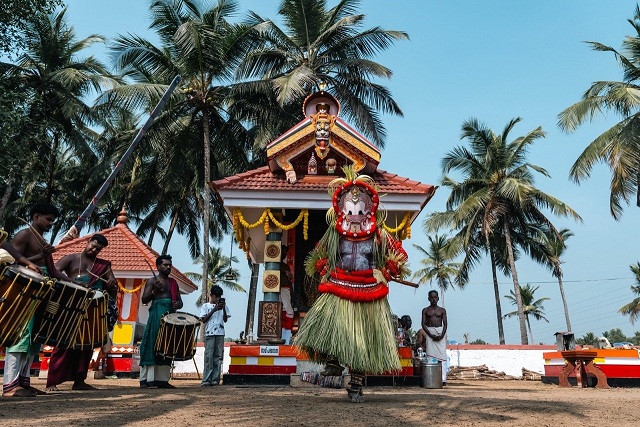
(Image Credit: Madras Photo Blog)
North Malabar was historically marked by a rigid caste order, with communities placed within strict social hierarchies. The communities who performed Theyyam themselves belonged largely to groups that occupied lower positions within this hierarchy. They lived with social restrictions and discrimination in their everyday lives.
The person who, outside the sacred temples, might have been denied social equality could enter the sacred space as a deity. People from different social backgrounds came before him. They bowed. They sought blessings. They brought their fears, illnesses, questions and prayers.
Theyyam, therefore, can be understood not only as a ritual of worship, but also as a living archive of social memory. A tradition preserved for centuries by communities placed at the margins of the traditional caste order became a space where their gods could stand at the centre.
Theyyam: Where Men Become Gods
We leave the path leading to the performance ground and enter a narrow passage into the grove. The forest grows thicker here. Old trees stand untouched, their fallen branches covered with moss and mushrooms. The sound of cicadas rises through the stillness, joined occasionally by the flutter of butterflies. Hidden among the trees is a small tiled hut—the place where the Theyyam performer prepares to leave behind his ordinary identity and enter the presence of the deity.
Inside sits a young man, not yet thirty. His face is almost completely painted, with deep shades of red and black forming intricate patterns. Everything seems to be waiting—the performer, the grove, the instruments and even the fading light. Neeliyar Kottam Theyyam begins close to sunset.
The transformation begins with materials drawn from the landscape itself. Rice paste provides the white, turmeric the yellow, while red—the dominant colour in many Theyyam performances—is traditionally prepared using turmeric and lime. Black is made from burnt paddy husk mixed with coconut oil. The elaborate mudi, or headgear, is constructed from lightweight natural materials such as areca nut, coconut, peacock feathers and shells. Nothing is merely decorative. Every colour, material and ornament becomes part of the visual language through which the deity is brought into presence.
But the transformation is not only physical.
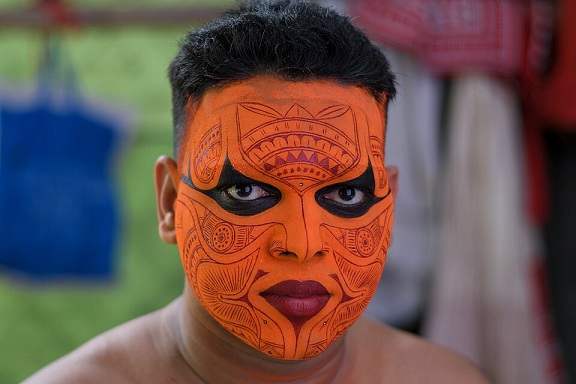
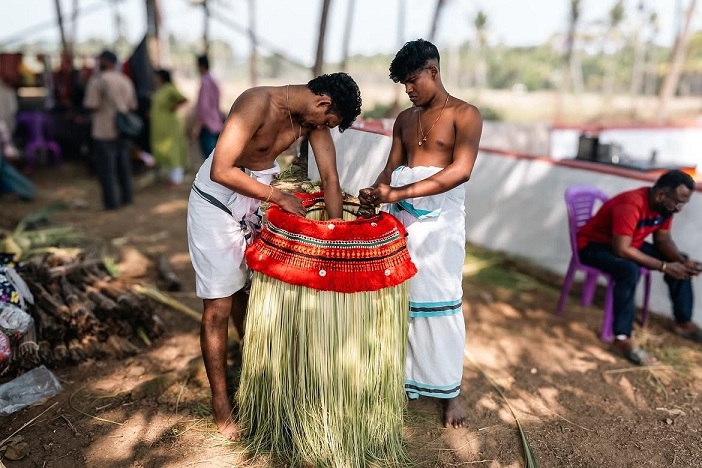
(Image Credit: 1. Wikipedia 2. Madras Photo Blog)
Before entering the ritual, the performer undergoes a period of preparation that may include abstinence, fasting, prayer and solitude. He learns the stories, traditions, movements and words associated with the deity he represents.
When the performance begins, he is no longer expected to speak simply as an ordinary person. He speaks as the deity, responding to the concerns of those who have come before him.
Then the song and music come together.
The Thottam Pattu tells the story of the deity—its origin, divine deeds, descent to earth, sacred dwelling and the blessings of worship. The deep beat of the Chenda, the metallic notes of the Elathalam, and the sounds of the Kurumkuzhal and Veekkuchenda gradually fill the grove. The rhythm rises, the painted face comes alive, and the elaborate headgear begins to move with the performer. What began as a young man sitting quietly inside a small hut now slowly transforms into the presence of the deity.
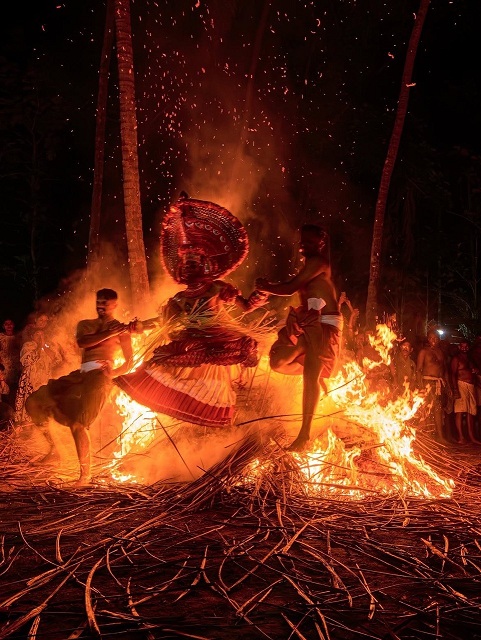
Fire enters some Theyyam traditions as another element of this transformation. Performers may walk through fire or carry burning torches around their bodies. As author of Theyyam: An Insider’s Vision, K. K. Gopalakrishnan observes, fire in certain Theyyam forms represents purification, divine energy and the transformative power of the ritual.
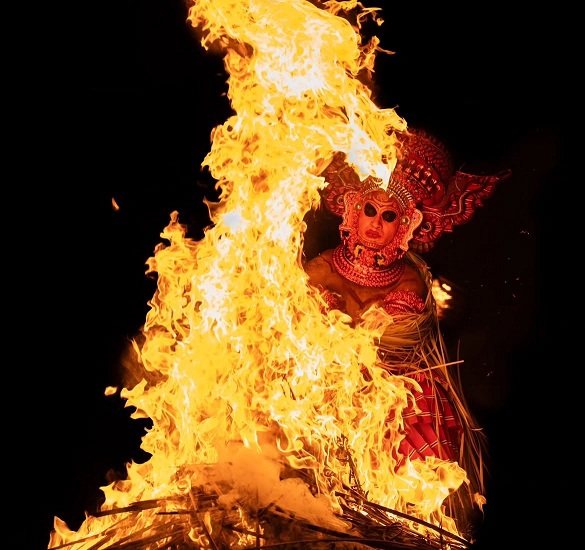
(Image Credit: Madras Photo Blog)
And then, the deity appears.
The most remarkable part of Theyyam is what happens next. The deity does not remain distant from the people. Devotees approach, speak, ask questions and share their fears and sorrows. The interaction is not between two ordinary individuals anymore, but between the devotee and the deity.
Through Vachal or Uriyadal—the sacred sayings of the Theyyam—the performer speaks about the deity’s origin, stories, experiences, proverbs and moral values. In these moments, Theyyam becomes more than a performance. It becomes a space where people seek guidance, reassurance and justice.
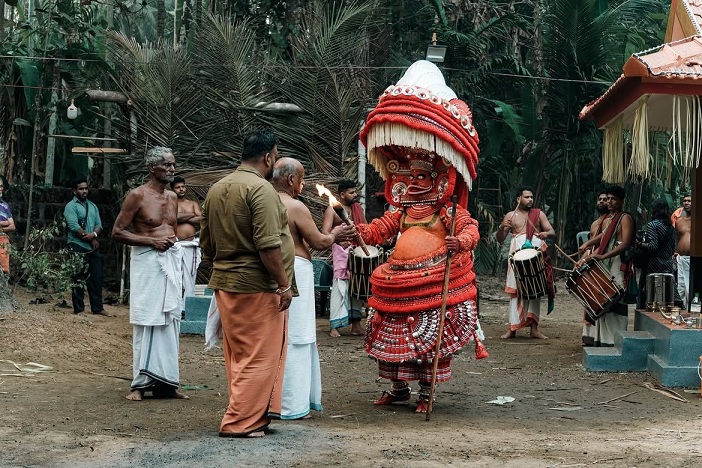
Vayanattu Kulavan Theyyam (Image Credit: Madras Photo Blog)
The deity listens.
A worried devotee may stand before the Theyyam and speak about a personal sorrow. The Theyyam may hold the person’s hand, offer a blessing and reassure them that they need not be afraid. In the language of the ritual, the deity often addresses devotees with the intimacy of an ancestor speaking to his own children.
For a few moments, the hierarchy of everyday life seems to disappear. The person who entered the grove as a young man now stands before the community as a deity.
Beyond the Spectacle: Understanding Theyyam Beyond the Performance
For those who come to Kannur in search of Theyyam, the first encounter is often overwhelming. The drums begin to rise. The colours become brighter. The performer appears transformed. A crowd gathers around the sacred grove. Cameras are lifted. People try to capture the moment when a human being appears to become something beyond human.
But Theyyam asks the visitor to look beyond the image.
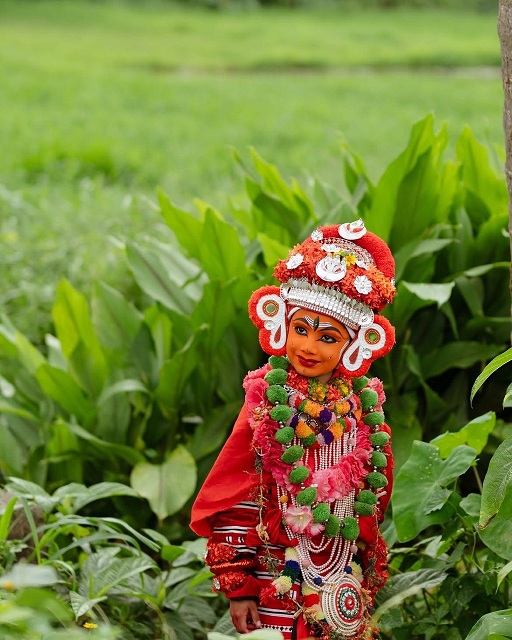
- Aadivedan Theyyam (Image Credit: Shahan Abdul Samad)
For City Heritage, this has been at the heart of its engagement with Theyyam from the beginning. Rather than presenting Theyyam simply as a dance or a spectacular visual performance, City Heritage has sought to explore it as a living ritual—one carrying centuries of memory, belief, community identity and history.
Over the years, people from different parts of India and from across the world have travelled to Kannur through City Heritage to experience Theyyam. Among them have been researchers, travellers and photographers drawn to one of the most extraordinary ritual traditions in the world.
When Theyyam Became a Photographer’s Journey
Few cultural traditions possess the visual power of Theyyam.
The towering headgear, intricate face painting, fire, movement, costumes and intense expressions have made Theyyam a subject of fascination for photographers across the world. For many, witnessing and photographing Theyyam has become part of a personal photographic journey—a place on the bucket list of those who document cultures and rituals.
But a powerful photograph of Theyyam requires more than a camera.
It requires time. It requires patience. And, above all, it requires understanding.
City Heritage has therefore helped photographers and photographic groups explore Theyyam beyond the camera frame—introducing them to its stories, rituals, communities and sacred spaces before they begin photographing. The idea is simple: the better one understands the ritual, the more meaningfully one can document it.

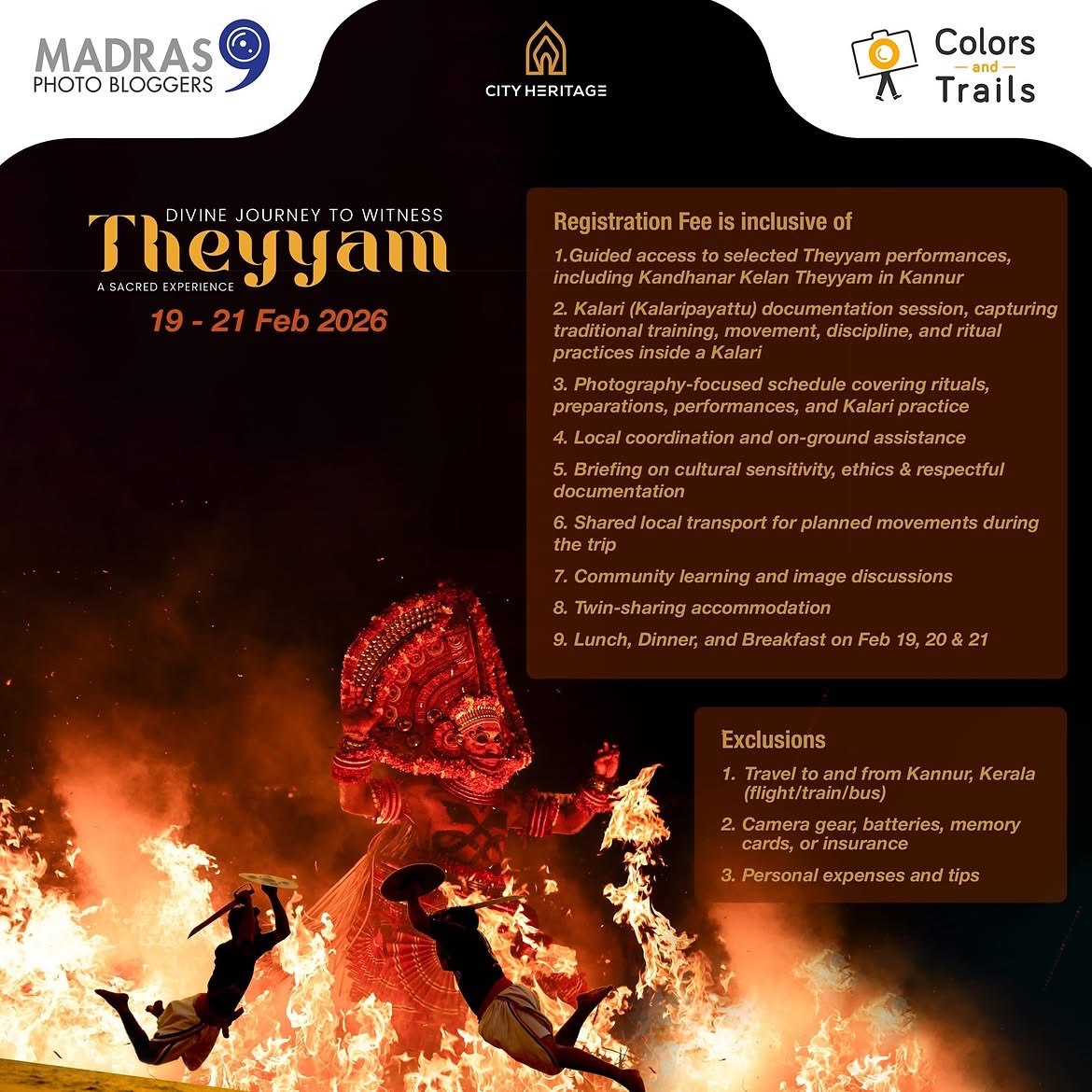
- City Heritage curated an immersive Theyyam experience for Madras Photo Bloggers and Colors & Trails.
Photography, in this sense, can become more than the creation of an image. It can become an archival record.
For more than a century, photographers have been documenting Theyyam. Their photographs have preserved faces, costumes, performances and moments that might otherwise have disappeared from living memory. Yet photography has also entered a new and more complicated age, where a sacred ritual can quickly become a photograph, a reel or a piece of online content.
This raises an important question: How do we photograph a living tradition without turning it into a spectacle?
When the Camera Became the Question: Theyyam Exhibition
This question became central to City Heritage’s exhibition at VERU Heritage Festival, held at David Hall, Fort Kochi: Theyyam: Why Are Photographers Being Prohibited from Using Cameras?
The exhibition brought together archival and contemporary photographs to look at the changing relationship between Theyyam and photography. Some of the archival images were more than a century old, reminding visitors that photographers have long been part of the visual history of Theyyam.
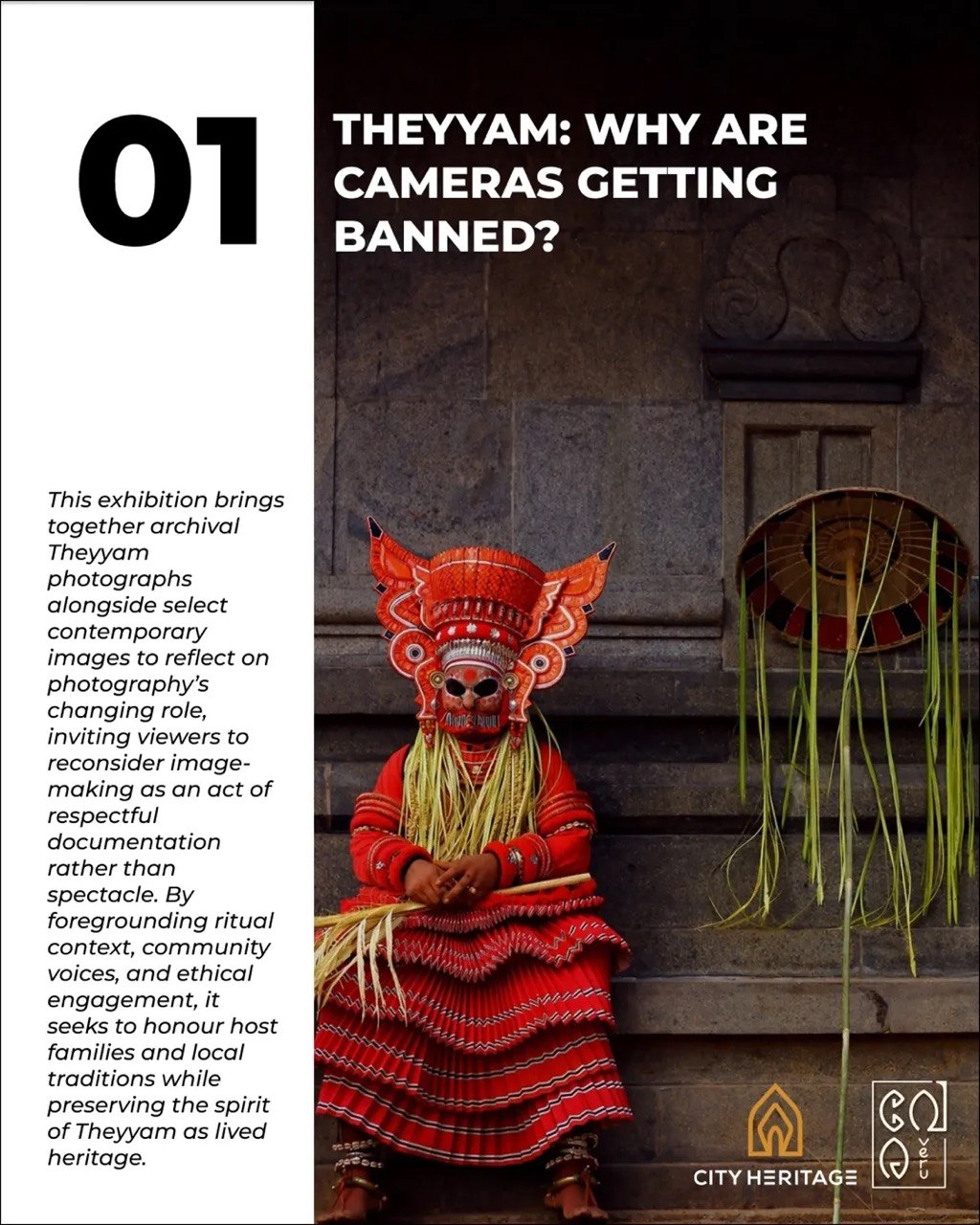
- City Heritage organized Theyyam Photography Exhibition at VERU Heritage Festival, held at David Hall, Fort Kochi.
The exhibition did not argue against photography. Instead, it asked us to think about how we photograph.
In recent years, some Theyyam shrines have introduced restrictions on photography because of growing concerns over intrusive photography, filming, vlogging and social-media content creation. In some instances, cameras and mobile phones have entered sacred spaces in ways that disturb the ritual and the people performing it.
The question, therefore, is not simply whether a camera should be present. The deeper question is whether the person behind the camera understands where they are standing.
The Theyyam exhibition placed this question at the centre of the conversation. Through archival photographs and contemporary documentations, it explored photography as a form of preservation—but also as a responsibility.
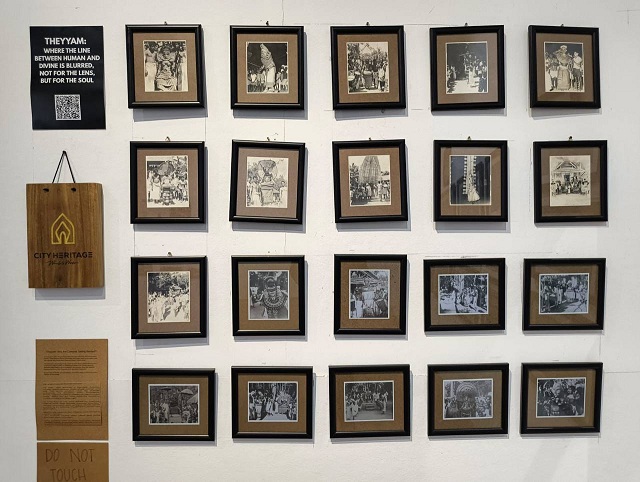
- From the Theyyam Photography Exhibition
Internationally experienced photography trainer Patric Filet, who has visited Kerala regularly for nearly three decades and documented the region since the mid-1990s, reflected on how dramatically the practice has changed. He observed the transition from the slower discipline of film photography to today's world of high-speed digital images, reels and instant sharing.
For him, the strongest photographs are often made by those who wait. Those who observe. Those who understand the ritual before pressing the shutter.
His observations echoed the position taken by City Heritage founder Muhammed Shihad.
“Photography and photographers have been an integral part of Theyyam for 126 years, as proven by archival records. We cannot and should not blame the entire process of photography for recent frictions.”
The concern, therefore, is not the camera itself. It is disrespectful. City Heritage believes that documentation should continue, but with consent, sensitivity and reverence for the ritual and the communities who preserve it.
Seeing the God Within: Experiencing Theyyam with City Heritage
For a visitor, the first sight of a Theyyam can be overwhelming. The towering headgear, the intricate face, the colours, the movement and the sound of the drums create an image that is almost impossible to forget.
But there is something beyond the scene. For the people gathered around the sacred grove, the person standing before them is not simply a performer. He is the deity.
That distinction changes everything.
Muhammed Shihad, founder of City Heritage, believes that this understanding should come before every Theyyam experience. A traveller approaching Theyyam must first recognize that this is not simply an art form created for an audience. It is a ritual deeply rooted in the cultural landscape of Northern Kerala—a tradition in which the performer is believed to embody the divine.
To enter a Theyyam ground, therefore, is not merely to enter a performance space. It is to enter a sacred world shaped by centuries of memory, belief, struggle and community.
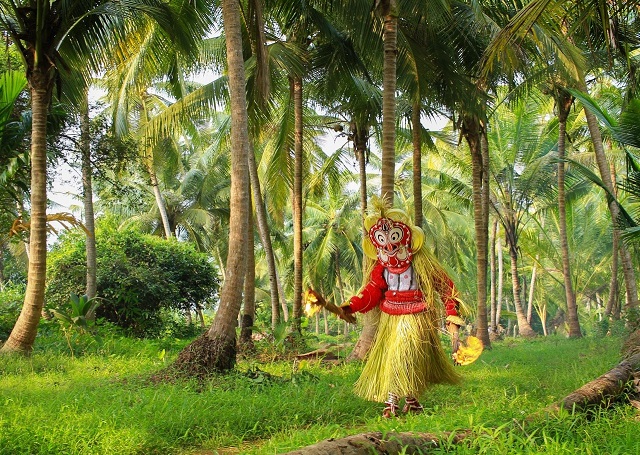
(Image Credit: Madras Photo Blog)
This is why City Heritage's Theyyam experiences seek to place understanding before spectacle. The journey is not simply about witnessing a Theyyam or finding the perfect photograph. It is about discovering the stories behind the deity, understanding the communities that preserve the ritual, listening to the music and oral traditions, learning the meaning of the sacred spaces, and recognizing the values that have allowed this tradition to survive across generations.
Because Theyyam is not something that belongs only to the past. It is a living legacy.
It continues to breathe in the sacred groves where rituals are still performed, in the families who inherit the knowledge, in the musicians who keep the ancient rhythms alive, in the artists who prepare the extraordinary costumes and faces, in the performers who become the deities, and in the stories that continue to travel from one generation to another.
References
Visit us and contact:
Experience Theyyam beyond the spectacle—with City Heritage, explore the rituals, stories, communities and living traditions that make North Malabar’s sacred landscape truly extraordinary.
Get in Touch:
Visit: www.cityheritage.in
Email: mail@cityheritage.in
Instagram: cityheritage.in
Phone: +91 7356569573, +91 8377024979




 (1).png)
© Copyright 2026 City Heritage. All rights reserved.
Website designed by TNM Online Solutions.
If you have any enquiry, feel free to ask, and we'll provide you with a prompt and concise response.