
Yasin Asharaf P | Published on 30/06/2026
There was an unusual sight on the football grounds of Koyilandy.
Among the barefoot local youngsters chasing the ball across the lush green fields was a young Arab man. He laughed, ran, and celebrated goals just like everyone else. To the people of Koyilandy, he was not a stranger but a friend who had travelled thousands of kilometres from the Arabian Peninsula.
His name was Ahmed Zaheer.
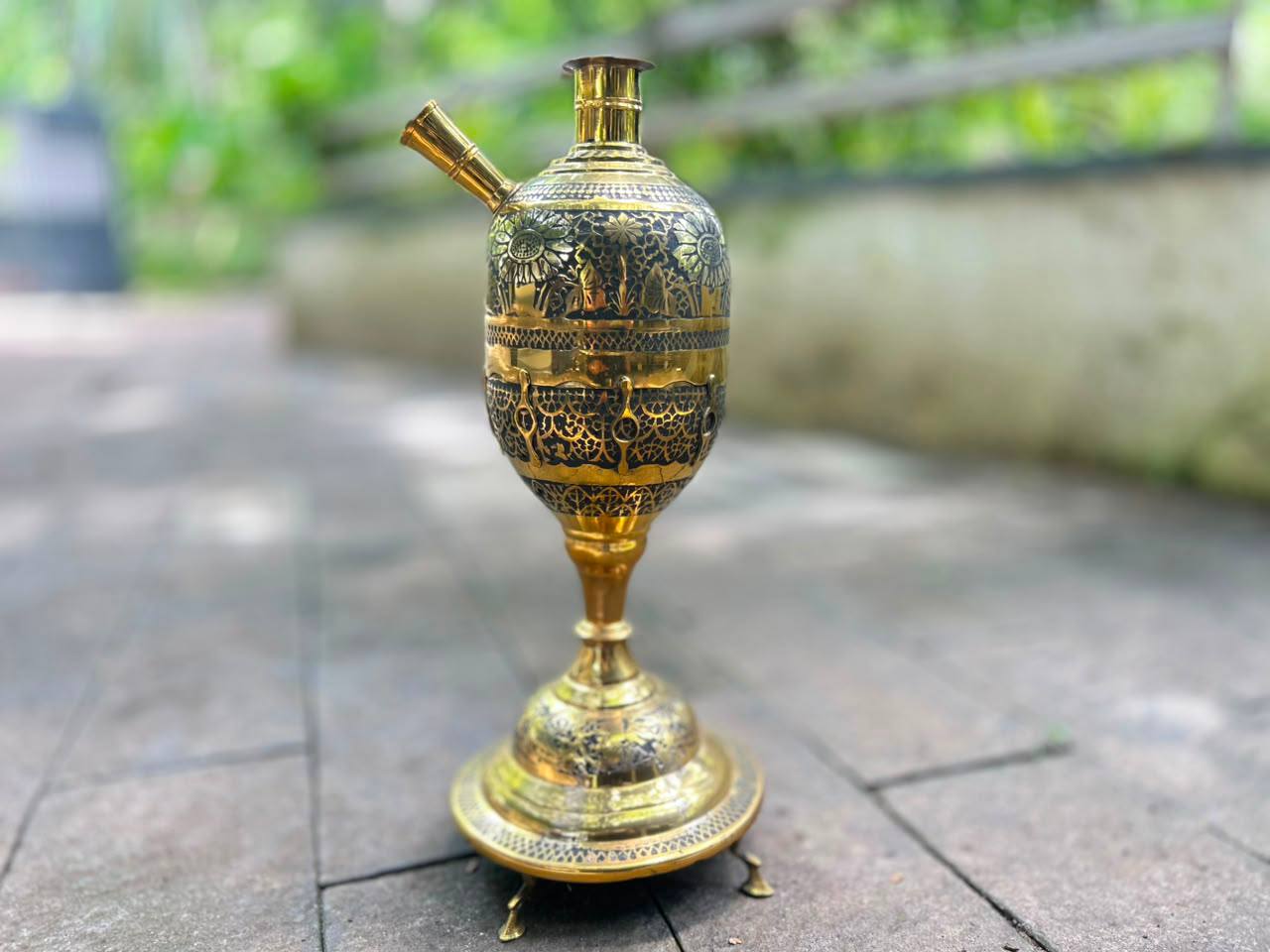
He had not come to Kerala as a tourist. Nor was he a football player. He had arrived in search of something that had connected the shores of Malabar with the Arab world for centuries—the handmade Koyilandy Hookah.
Curious about the legendary craftsmanship that produced these elegant smoking pipes, Ahmed spent days visiting workshops, observing artisans, and meeting exporters. Among those he befriended was Hashim K.M., one of Koyilandy's leading hookah exporters. Their conversations often stretched late into the evening, and in between discussions about trade and craftsmanship, they found time for football.
Even today, decades later, Hashim remembers those moments with a smile.
Sitting in the verandah of his ancestral home, where an old hookah now stands quietly as a flower pot, the 78-year-old recalls an era when Arab merchants were not merely customers but guests of the family.
"They stayed in our home," Hashim says. "They ate with us, played football with us, and became part of our lives."
That friendship tells a much larger story.
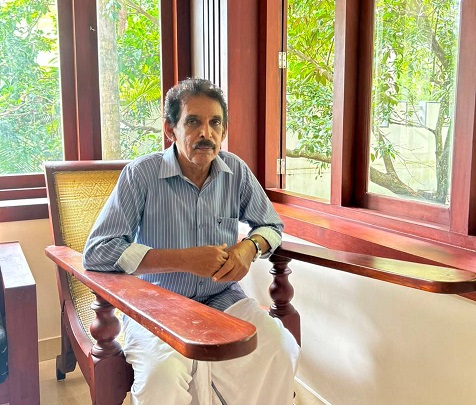
- Hashim K.M. tell the stories from his home in Koyilandy.
For centuries, Koyilandy was far more than a coastal town. It was one of the important gateways of the Indian Ocean trading world. Nearby Panthalayani was a historic harbour where Arab merchant ships anchored long before the arrival of European colonial powers. It was also here that Vasco da Gama first reached the Malabar Coast in 1498, marking the beginning of European colonial intervention in India.
Long before colonial ships arrived, however, Arab traders had woven Koyilandy into an extensive maritime network that connected Kerala with Yemen, Oman, the Hijaz, and the wider Gulf. They traded spices, timber, coconut products, and countless other commodities that travelled across the Arabian Sea.
Among these was an object that eventually became synonymous with Koyilandy itself—the handmade hookah.
According to Hashim, the story began nearly four centuries ago. Arab merchants introduced the basic hookah design to the Malabar Coast. Inspired by their visitors, local Mooshari (traditional metal artisans) began experimenting with materials readily available in Kerala. They crafted hookahs using brass, bronze, copper, zinc, silver, and one distinctly local element—the large coconut shells of Kuttiady.
The result was unlike anything produced elsewhere.
The coconut shell gave the Koyilandy hookah its distinctive character, blending Arabian design with Kerala's natural resources and indigenous craftsmanship. It was both functional and artistic, carrying the identity of Malabar across the Indian Ocean.
Soon, Koyilandy became the world's only centre exporting handmade coconut-shell hookahs on a commercial scale.
- The Koyilandi Hookah
For generations, these hookahs travelled by rivers and inland waterways to the coast before being loaded onto ships bound for Jeddah, Riyad and other parts of the Arab world. In Bedouin tents beneath date palms, during festivals and daily gatherings alike, the Koyilandy hookah became an integral part of Arab social life.
At its peak during the 1980s and 1990s, the industry was flourishing.
Nearly fourteen export firms operated from Koyilandy. Together they handled more than 7,000 handmade hookahs annually. Every month, several export consignments left for the Middle East, providing employment to hundreds of artisans.
Nearly 200 families of skilled blacksmiths and craftsmen from Koyilandy, Ulliyeri, Kollam, and surrounding villages devoted themselves to hookah production. Small workshops lined the coastal settlements, where brass was hammered, coconut shells polished, and intricate decorative patterns engraved by hand.
The company was founded in 1979 by M.C. Bavakkutti after his return from Rangoon, became one of the industry's most prominent names. His son, Hashim K.M., joined the family business alongside his brother and witnessed the industry's golden years.
"There were nine exporters during my time," Hashim recalls. "Hundreds of people worked in small sheds along the Koyilandy coast. Today, I am probably the last exporter still remaining."
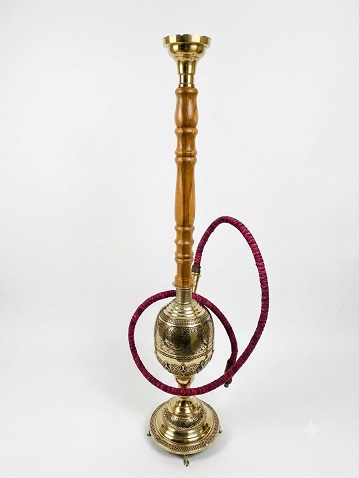
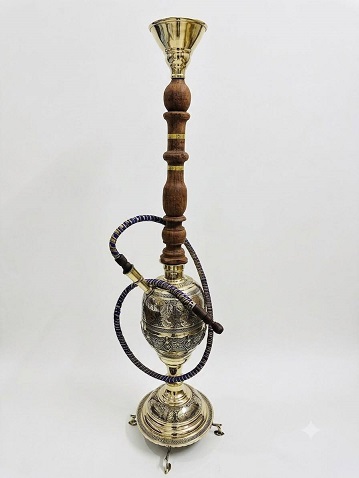
- The Koyilandi Hookah
His memories are filled with stories of prosperity.
"The Arabs preferred doing business with people they knew personally. They stayed in our house, and played football with us. We used to receive orders for three or four containers every year. Each container carried hundreds of boxes, amounting to nearly 6,000 hookahs worth around forty lakh rupees. Those were wonderful days."
It is the story of Kerala's maritime history, of centuries-old Arab-Malabar relations, of traditional artisans who transformed local materials into objects admired across the Middle East, and of a remarkable cultural exchange that extended far beyond trade.
Like the famous Uru shipyards of Beypore, which continue to build wooden vessels for Arab royalty, the Koyilandy hookah represents another extraordinary chapter in Malabar's shared heritage with the Arabian Peninsula. Yet unlike the Uru tradition, this once-thriving craft now stands on the brink of disappearance.
The Art of Making the Koyilandy Hookah: Crafted from Brass and Coconut Shells
Unlike modern factories filled with machines, the Koyilandy hookah was born in humble sheds and makeshift workshops scattered across Koyilandy, Ulliyeri, and neighbouring villages. Beneath tin roofs and coconut-leaf shelters, generations of artisans transformed raw metal and coconut shells into one of the most distinctive craft products of the Malabar Coast.
Every hookah carried the touch of human hands.
"There was no factory," recalls Hashim K.M. "Different people specialised in different stages of the work. Every part was handmade before it finally became a complete hookah."
The making of a single hookah was a community effort. Moosharis (traditional metal artisans), blacksmiths, polishers, woodworkers, and even women who assisted with finishing work all played their part. Small workshops across Koyilandy produced individual components before they were brought together for the final assembly and polishing.
Hashim smiles as he explains the process.
"Whether we make one hookah or one hundred, the production time is almost the same because every stage depends on the previous one. It usually takes two to three months to complete an order."
The hookah itself was a remarkable blend of Kerala's natural resources and traditional craftsmanship. Brass, bronze, copper, zinc, and silver formed the elegant exterior, while its heart was made from one of Kerala's most abundant gifts—the large coconut shells of Kuttiady, renowned for their size and strength.
Unlike the glass bowls commonly found in modern hookahs manufactured elsewhere, the Koyilandy hookah used carefully selected and seasoned coconut shells. The shells were believed to absorb minute impurities from the water inside, adding both functionality and a uniquely Malabar identity to the product.
The top portion of the giant coconut was carefully cut and hollowed before being fitted inside the beautifully crafted brass body. Silver embellishments added brilliance, while skilled craftsmen engraved intricate floral motifs, sea waves, ships, fish, and traditional Arabic-inspired patterns onto the metal surface. Each hookah became a work of art, reflecting centuries of maritime exchange between Malabar and the Arab world.
The journey of making a hookah began with wood.
Artisans first carved wooden models of different sizes and designs. These wooden frames were coated with molten wax before being covered with layers of clay. After drying for nearly a week, the moulds were placed inside a furnace, where the wax melted away, leaving hollow cavities. Molten brass was then poured into these spaces, creating the beautifully shaped metal components that would later embrace the coconut shell.
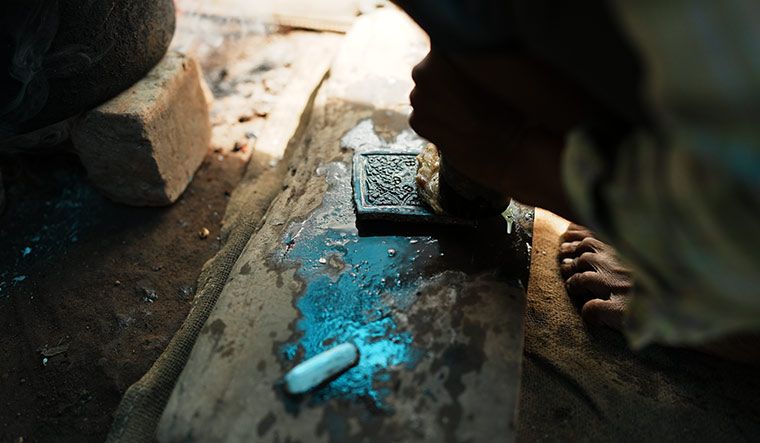
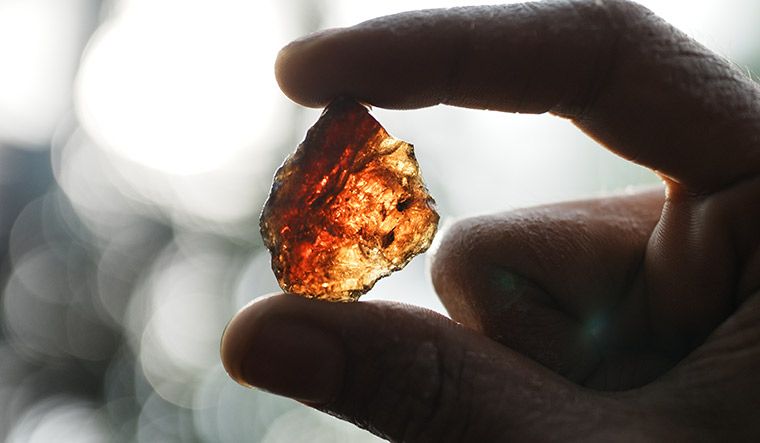
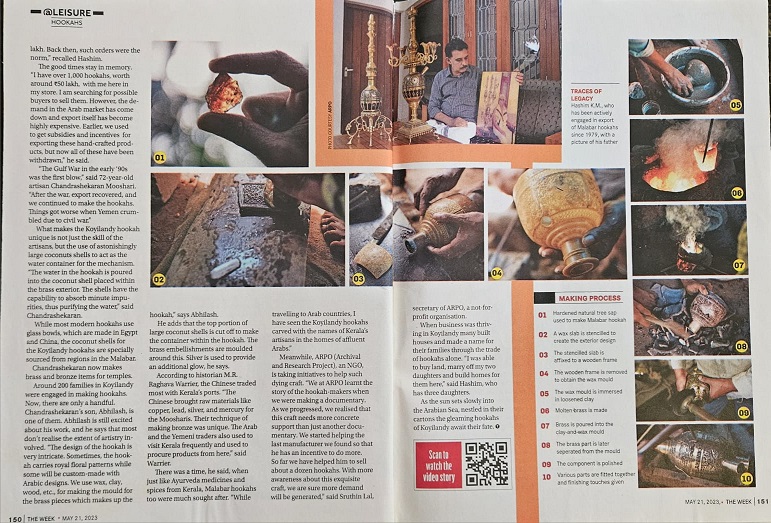
- A wax slab is stencilled to create the exterior design. & - Hardened natural tree sap used in making the Malabar Hookah. (Credit: The Week)
Every stage demanded extraordinary patience.
At a single artisan household in Kollam, five craftsmen working together could complete only about fifty hookahs in an entire month. Nothing was hurried. Every curve, engraving, and fitting required precision that only years of experience could achieve.
For decades, nearly two hundred artisans across Koyilandy, Ulliyeri, and Kollam depended on this industry. Entire families earned their livelihood through hookah making. Men worked with metal, women assisted in finishing processes, and younger generations gradually learned the craft by observing their elders.
Some components, however, travelled even farther. The smoke pipes, valves, and tobacco stems were procured from Moradabad in Uttar Pradesh, where craftsmen specialised in manufacturing these standardised fittings. Once they reached Koyilandy, they were assembled with the handcrafted coconut-shell body, completing a product that was unmistakably known across the Gulf as the Koyilandy Hookah.
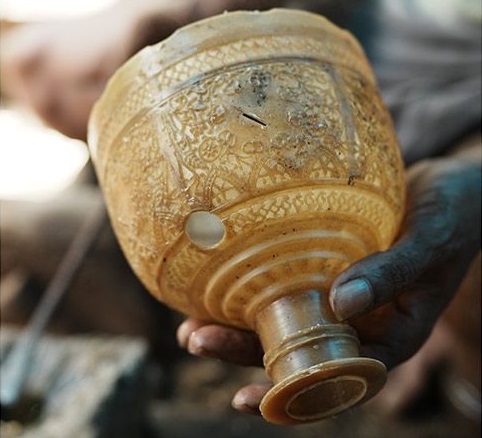
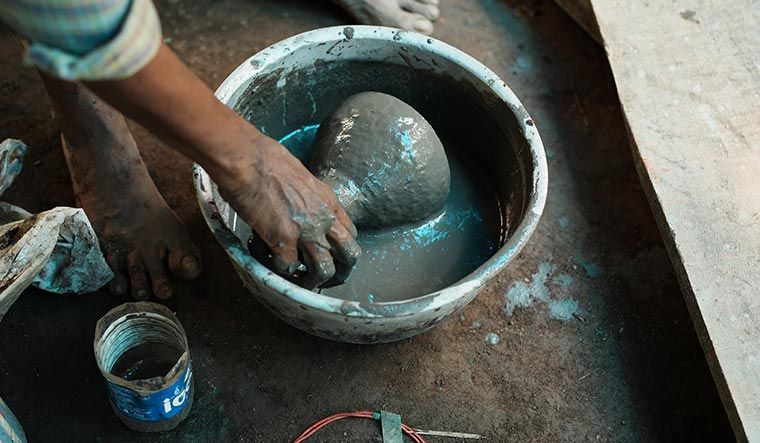
- Different Stages in the Making of the Koyilandy Hookah (Credit: The Week)
Most export orders came from Saudi Arabia, where buyers preferred two distinct varieties. Nearly eighty percent were the traditional flat-based models, standing between thirteen and eighteen inches tall. The remaining twenty percent consisted of the more elaborate "leg-type" hookahs, admired for their decorative appearance.
Large hookahs, however, gradually disappeared.
Finding perfectly shaped coconut shells measuring twenty to twenty-two inches in diameter became increasingly difficult. Without these shells, artisans could no longer fulfill orders for the giant ceremonial hookahs that had once been among Koyilandy's finest creations.
At its peak, an average export order from Saudi Arabia consisted of nearly 1,500 hookahs. Completing such an order required almost three months of continuous work, engaging around one hundred artisans and supporting dozens of households whose livelihoods depended entirely on the craft.
Today, many of those workshops have fallen silent.
The craftsmen who once shaped brass with remarkable skill have moved into other occupations. Younger generations have little opportunity to continue the tradition. Only a handful of artisans remain, preserving techniques passed down through centuries.
Looking at one of the few hookahs left in his warehouse, Hashim reflects quietly.
"This is not just a hookah," he says. "It is the original Koyilandy Hookah. It was born here, on the shores of Panthalayani, using the natural resources of Kerala. This land gave it its identity."
Across the Arabian Sea: The Koyilandy Hookah's Journey to the Arab World
Long before cargo containers and modern shipping routes transformed global trade, the handmade hookahs of Koyilandy were already crossing the Arabian Sea.
Packed carefully in sturdy wooden crates, each hookah began its long voyage from the quiet workshops of Malabar to the bustling ports of the Middle East. Their final destination was not merely a marketplace but the homes, tents, palaces, and majlis of the Arab world, where the Koyilandy Hookah became a symbol of hospitality, leisure, and social life.
From the vast Bedouin tents pitched beneath date palms in the Arabian deserts to the elegant drawing rooms of royal households in Saudi Arabia, Yemen, Oman, Qatar, and beyond, these beautifully handcrafted hookahs became part of everyday life.
Known as Sheesha in Arabic, the hookah was much more than a smoking instrument. Water filled the coconut-shell chamber, while tobacco placed in the bowl above was heated with glowing charcoal. As the smoke travelled through the water before passing into the beautifully decorated hose, it became cooler and smoother. This ritual of preparing and sharing a hookah gradually became an enduring tradition across the Middle East, bringing together families, friends, and guests.
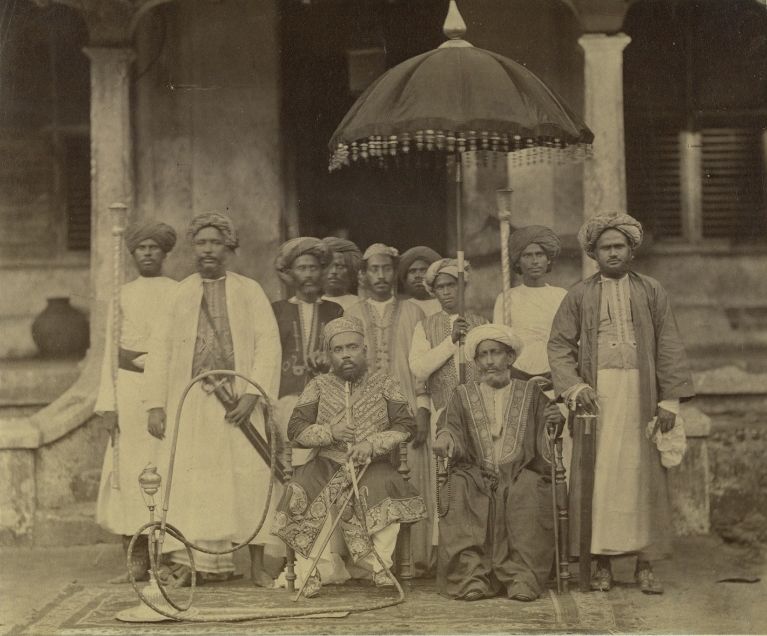
- An archival photograph showing the Arakkal royal family of Kannur with a hookah, a symbol of prestige.
For generations, the finest hookahs used in many Arab homes originated not from the Middle East itself, but from the small coastal town of Koyilandy on Kerala's Malabar Coast.
"The Arabs trusted us," recalls Hashim K.M. "Business was built entirely on relationships."
There were no advance payments. Trade was conducted through Letters of Credit, backed by years of mutual confidence between Arab merchants and the exporters of Koyilandy. It was a partnership strengthened by honesty, and generations of friendship.
Hashim vividly remembers those journeys.
"We packed every hookah carefully in wooden boxes," he says. "The consignments were loaded onto large lorries and transported from Koyilandy to Kochi. From Kochi they were shipped to Sri Lanka, where they were transferred onto the large mother ships that sailed to the Arab world. Those ships were too large to dock at Kochi, so Sri Lanka became the connecting point for our exports."
It was a remarkable maritime journey that echoed the ancient Indian Ocean trade routes linking Malabar with Arabia for centuries.
The tobacco used in these hookahs came mainly from Calcutta and regions of present-day Pakistan. Once assembled in Arabia, the Koyilandy Hookah became the centrepiece of evening gatherings, festivals, weddings, and family celebrations. Whether in a desert encampment or an urban majlis, sharing a hookah symbolised conversation, hospitality, and companionship.
The industry reached its peak during the 1980s and 1990s.
Nearly nine export houses operated from Koyilandy, each maintaining close commercial relationships with Arab buyers. The Exporters regularly shipped thousands of hookahs every year to Saudi Arabia and neighbouring Gulf countries.
Behind every export consignment stood an entire community.
Muslim exporters coordinated international trade with their long-standing Arab partners, while hundreds of artisans belonging to different communities across Malabar—particularly the Moosharis (traditional metal craftsmen), Kollans (blacksmiths), polishers, carpenters, and transport workers—worked together to complete each order.
Every shipment represented months of collective labour.
When large orders arrived from Saudi Arabia, workshops across Koyilandy, Ulliyeri, and Kollam sprang into action. Metal echoed beneath small sheds, coconut shells were carefully selected and seasoned, craftsmen engraved intricate floral and maritime motifs, and families worked tirelessly to complete consignments destined for the Arabian Peninsula.
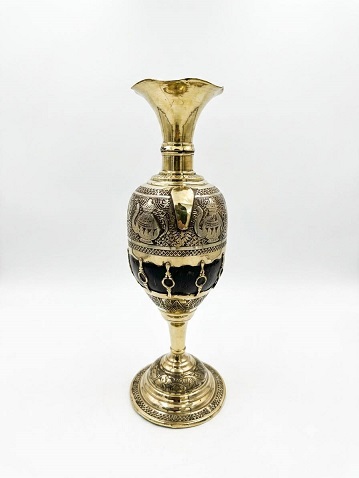
- The Koyilandi Hookah
For Hashim and many others, those were years of prosperity.
"There was work everywhere," he remembers. "Hundreds of people earned their livelihood from the hookah industry. The workshops were always busy, and ships regularly carried our products across the Arabian Sea."
The Koyilandy Hookah was more than an export commodity. It was a cultural ambassador of Malabar.
Every hookah carried within it the coconut trees of Kerala, the craftsmanship of its artisans, and the centuries-old friendship between the people of Malabar and the Arab world.
The Last Guardian of the Koyilandy Hookah
Today, silence has replaced the rhythmic sound of hammers that once echoed through the hookah workshops of Koyilandy.
The bustling sheds where hundreds of artisans shaped brass, polished coconut shells, and engraved intricate patterns now stand largely abandoned. Only a handful of craftsmen continue to practise the skills that once sustained entire communities along the Malabar Coast.
For Hashim K.M., the decline did not happen overnight.
"It happened little by little," he says quietly.
The first major blow came with the Gulf War of 1991. Export routes were disrupted, international sanctions affected trade, and the movement of goods across the Middle East became increasingly difficult. A business that had flourished for generations suddenly found itself caught in the uncertainties of global politics.
The crisis deepened with every passing decade.
The Iran-Iraq conflict had already weakened long-established trading networks. Later, restrictions on exports to Yemen—one of the world's largest consumers of traditional hookahs outside the holy city of Makkah—further reduced demand. More recently, the conflict in Yemen disrupted the supply of specialised hookah pipes, traditionally manufactured by skilled Yemeni craftsmen using unique metal alloys.
Wars fought thousands of kilometres away slowly reached the quiet workshops of Koyilandy.
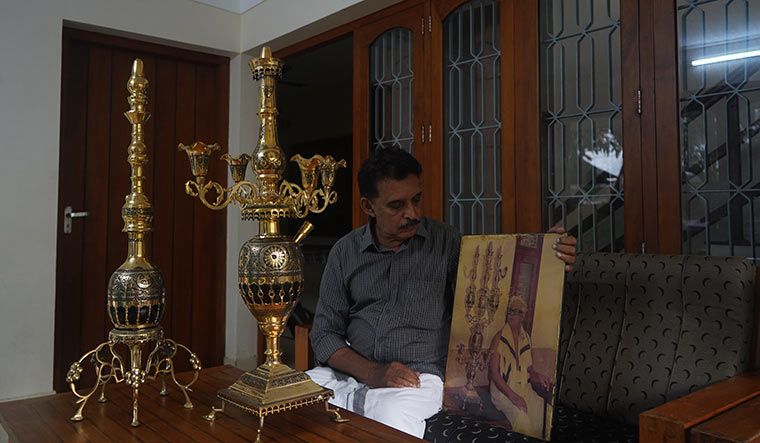
- Hashim at his home with a portrait of his father. (Credit: The Week)
The challenges were not only international.
The cost of raw materials rose sharply. Brass, copper, zinc, silver, transport, and labour became increasingly expensive. The large Kuttiady coconuts required for traditional hookahs became harder to obtain, making production even more difficult.
Meanwhile, the market itself was changing.
Across the Gulf, younger generations were moving away from the traditional handcrafted hookah. Machine-made products manufactured in China and Egypt entered the market at much lower prices. Glass hookahs, produced in large factories, quickly became popular.
The Koyilandy artisans simply could not compete with mass production.
What once required months of careful craftsmanship could now be produced in factories within days.
Then came another devastating setback.
The COVID-19 pandemic brought international trade to a standstill. Transport costs increased dramatically, export logistics became uncertain, and many artisans lost the little work that remained. Some left the craft forever in search of more stable employment.
"People now prefer construction work," Hashim says. "Many of the older craftsmen have passed away. The younger generation has little interest in learning the craft. Only a few expert hookah makers are left."
For him, the greatest loss is not financial.
"We are saddened not because the business declined," he says, pausing before continuing. "We are saddened because we are losing our history. The Koyilandy Hookah is part of the heritage of Malabar and a symbol of the centuries-old relationship between Kerala and the Arab world."
Hashim also believes that the absence of sustained government support accelerated the industry's decline.
He recalls a brief period when export incentives, duty drawbacks, and subsidies provided some relief to artisans and exporters. Those measures, however, were later withdrawn, leaving traditional craftsmen to compete in a global market without meaningful institutional support.
"Our government is not doing enough to preserve this heritage," he says. "We do not believe the next generation will continue this work. There is very little hope."
His warehouse tells the same story.
Rows of beautifully handcrafted hookahs remain carefully stacked inside, waiting for buyers who may never come. Only limited pieces left, worth several lakhs of rupees, lie preserved—not because there is no demand for their beauty, but because exporting them has become increasingly difficult and expensive.
More Than a Hookah: A Living Legacy of Kerala’s Arab Connections
Ironically, the Koyilandy Hookah has begun to live a second life.
Today, many of the remaining Koyilandy hookahs are no longer purchased for smoking. Instead, they are collected as heritage objects and works of art. Diplomats, senior civil servants, business leaders, and cultural enthusiasts proudly display them in their homes as reminders of Kerala's rich maritime history and centuries-old connections with the Arab world.
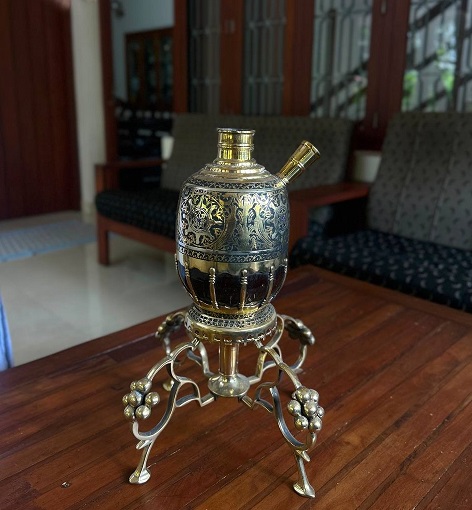
As our conversation comes to an end, Hashim looks at one of the handcrafted hookahs standing quietly in the verandah of his home, now serving as a flower pot.
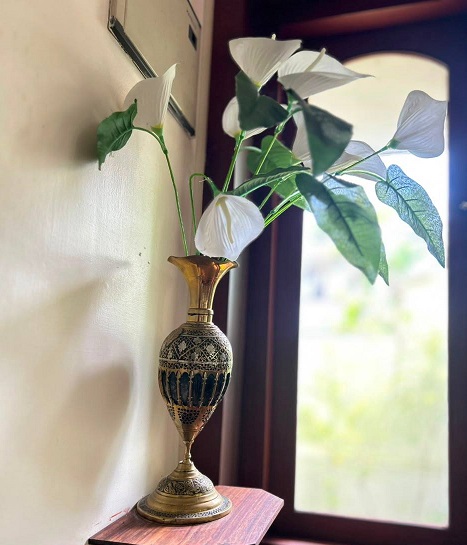
- A Hookah repurposed as a flower pot in the verandah of Hashim's home.
It is a powerful symbol of the journey the craft itself has taken—from the bustling ports of Panthalayani to the deserts of Arabia, from thriving export warehouses to quiet memories.
His final words carry both sorrow and hope.
"We need to tell the people of Kerala and India that this is their own heritage. The Koyilandy Hookah is not merely an old product—it is a living reminder of the centuries when Arab ships reached the shores of Malabar. This tradition deserves to be celebrated, protected, and supported before it disappears forever."
His appeal is not simply about preserving an old craft. It is about safeguarding a chapter of Kerala's history—a story of maritime trade, cultural exchange, skilled craftsmanship, and friendships that crossed the Arabian Sea for more than four centuries.
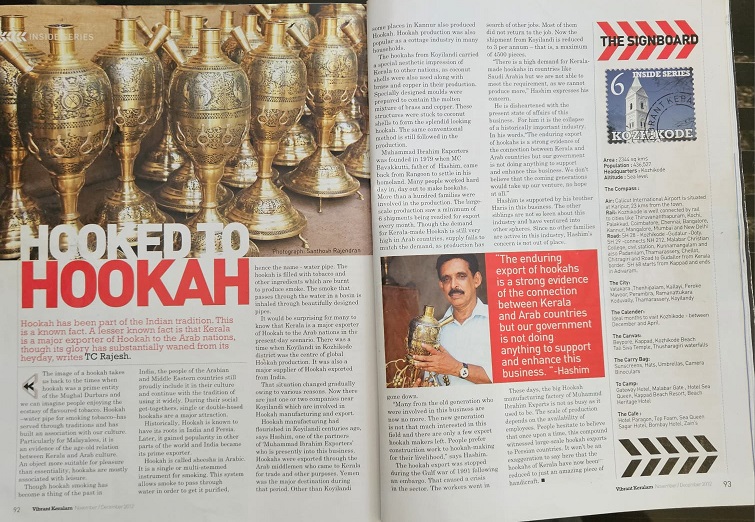
- An article on the Koyilandy Hookah and Hashim featured in Vibrant Keralam magazine.
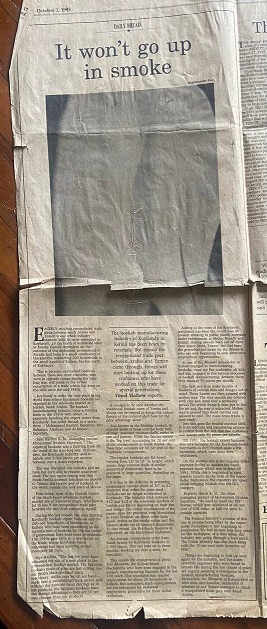
1. An article from The Hindu on the prosperous period of the Koyilandy Hookah, published in 1992.
2. An article on the Koyilandy Hookah published in The Week magazine.
Some stories survive in books. Others survive in monuments.
The story of the Koyilandy Hookah survives in the hands of a few ageing craftsmen and in the memories of Hashim K.M., the last exporter who still believes that this is not merely a handcrafted object, but a living symbol of four centuries of friendship between Kerala and the Arab world.
Whether this remarkable legacy continues—or quietly fades into history—depends on whether we choose to remember it today.
Contact Us
A limited collection of authentic handcrafted Koyilandy Hookahs, created by the last traditional makers of this historic craft, is still available.
Those who wish to own, preserve, and support this unique heritage are warmly invited to contact us directly.
To place an order or for further enquiries, please contact us:
Phone: +91 7356569573, +91 8377024979
Email: mail@cityheritage.in
Visit: www.cityheritage.in
Instagram: cityheritage.in




 (1).png)
© Copyright 2026 City Heritage. All rights reserved.
Website designed by TNM Online Solutions.
If you have any enquiry, feel free to ask, and we'll provide you with a prompt and concise response.