
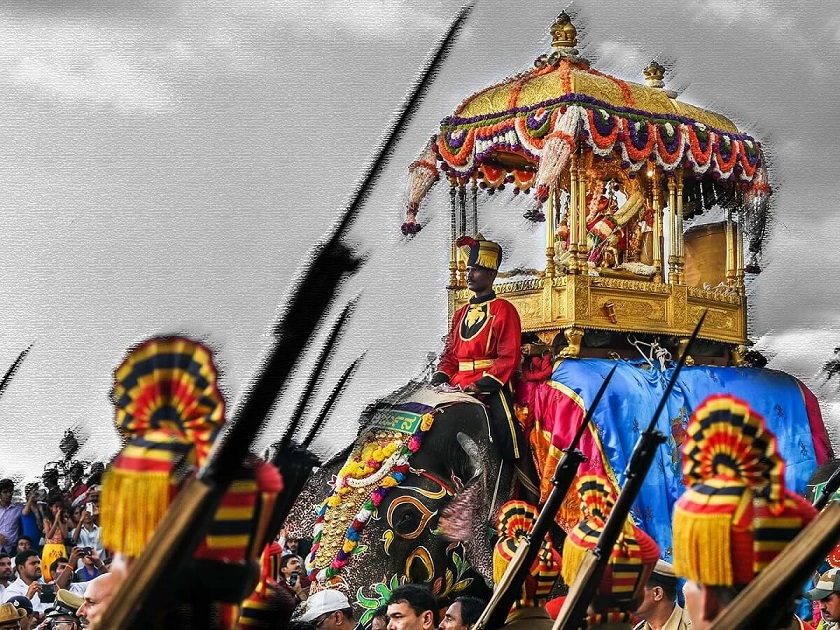
Mysuru—the famed City of Palaces—changes its rhythm for a few extraordinary days every autumn. Streets glow beneath thousands of lights. The old palace rises like a luminous backdrop to the night. Music drifts through public spaces, markets become crowded, visitors arrive from across India and beyond, and the city begins to feel as though its royal past has stepped quietly into the present.
And at the centre of it all stands Mysuru Palace.
But Mysuru Dasara is not simply about a palace, an illuminated city or a spectacular procession. It is a story that reaches much further back—to the ceremonial world of the Vijayanagara Empire, to the Wadiyar rulers of Mysuru, to royal rituals, military symbolism, music, art and public celebrations, and eventually to the transformation of a royal festival into Karnataka's Nada Habba, its state festival.
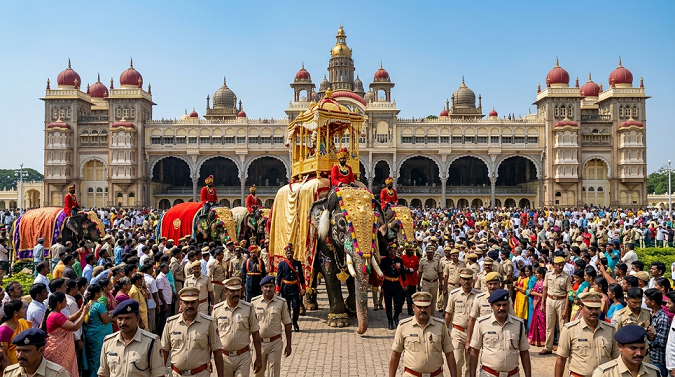
- Mysuru Dasara Procession (Image: redbus.in)
This October, that story will unfold once again.
Mysuru Dasara 2026 is scheduled from 11 October to 21 October. The celebrations are set to begin with rituals at Chamundi Hill, followed by cultural programmes, illumination, sporting and other events across the city. The traditional grand finale will centre on the Jamboo Savari.
The Ten Days of Mysuru Dasara: Rituals, Royalty and Grand Celebration
Mysuru Dasara unfolds over ten days, moving from sacred palace rituals to one of Karnataka’s grandest public celebrations. The festival brings together devotion, royal traditions, martial heritage, music and culture.
The celebrations begin with rituals dedicated to Goddess Chamundeshwari, along with the worship of the Navagrahas, royal throne and state sword. The following days feature Vedic rituals, traditional durbars, wrestling and athletic performances, reflecting Dasara’s historic connection with kingship.
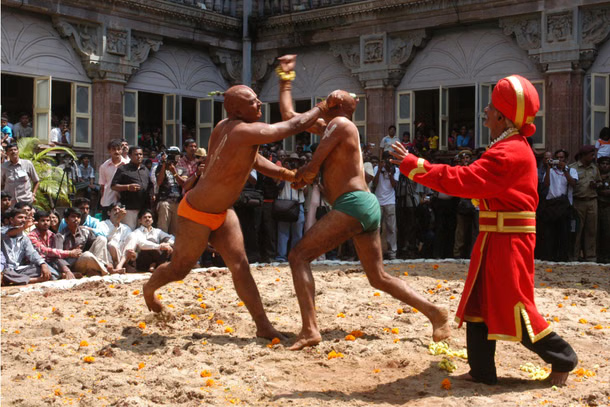
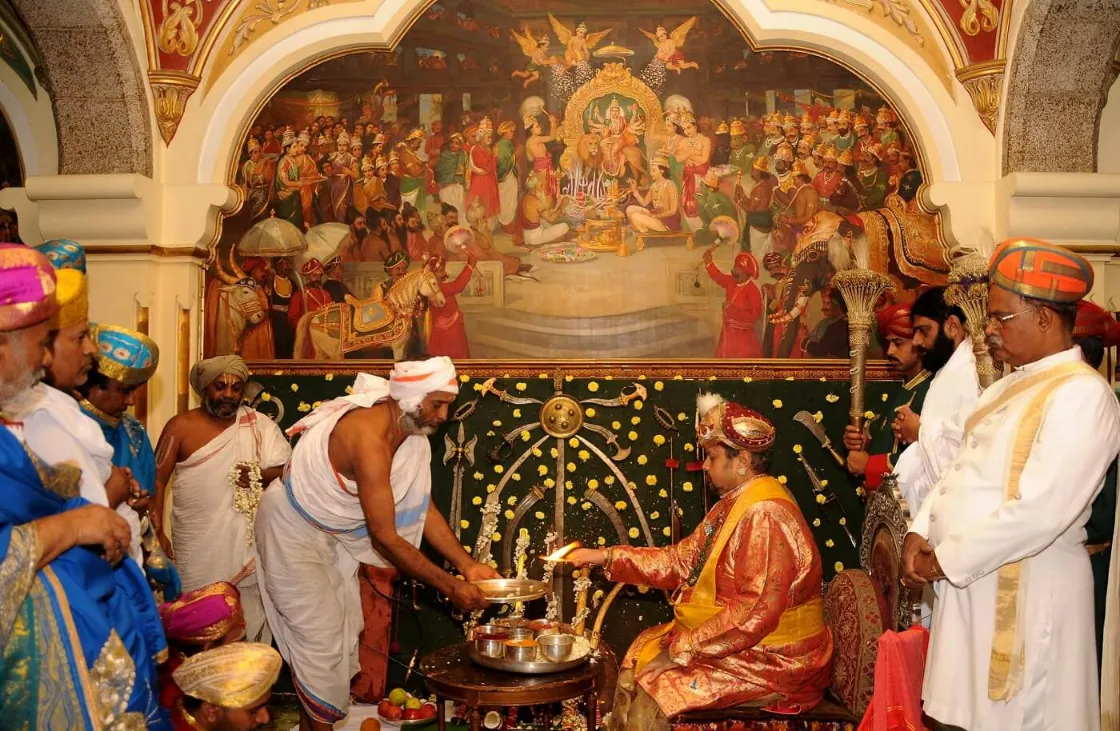
- Wrestling in the palace ground & Sacred rituals for Goddess Chamundeshwari inside the palace (Image: savaari.com)
As the festival progresses, Saptami honours Sarasvati through the worship of books and manuscripts, while Durgashtami recalls the goddess’s victory over Mahishasura.
Then comes Mahanavami, the ninth day, marked by Ayudha Puja, when weapons, agricultural and trade implements, household objects and state insignia are worshipped. The day vividly recalls the martial and ceremonial character of the old royal Dasara.
Then comes the tenth day—Vijayadashami.
After nine days of rituals and celebrations, Mysuru Dasara reaches its grand finale with the Jamboo Savari, which sets out from Mysore Palace towards Bannimantap. Once a royal procession led by the Maharaja, it traditionally featured the state arms, the golden ambari, the state elephant and ceremonies at Bannimantap.
Today, the procession brings together decorated elephants, music, dancers, tableaux and cultural groups, with Goddess Chamundeshwari carried in the golden howdah at its heart. Dasara concludes on Vijayadashami night at Bannimantap with the torchlight parade, a historic display once meant to instill public confidence and showcase the king's military prowess.
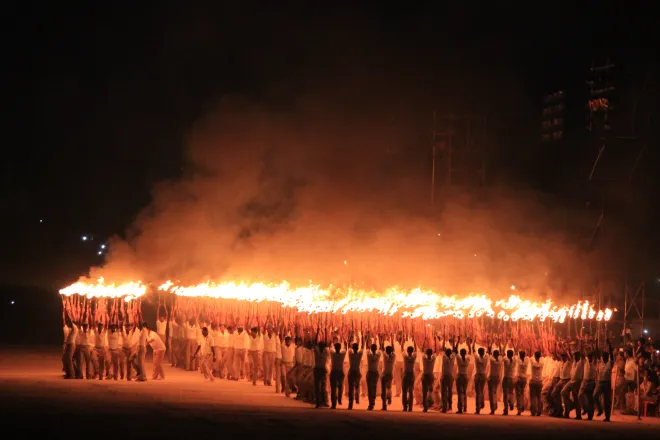
- Procession of Mysore Dasara & The Torchlight Parade (Image: Google)
More than a spectacle, the Jamboo Savari is a moving archive of Mysuru’s past—preserving memories of royal ceremonies, martial traditions and sacred rituals, while transforming them into a celebration shared by the people of Mysuru and visitors from around the world.
The legend of Chamundeshwari
Yet beneath the royal ceremonies and historical layers lies another story—the sacred story of the Goddess.
Look towards Chamundi Hill, and the mythology of Mysuru becomes visible. According to the traditional Hindu account, the region was associated with the buffalo demon Mahishasura, who was defeated by Goddess Chamundeshwari, a form of Durga.
The name Mysuru itself is traditionally connected with Mahishasura.
At Dasara, Chamundeshwari is not simply remembered as a distant mythological figure. She occupies the heart of the festival. The celebrations begin at Chamundi Hill. And on Vijayadashami, her image becomes the central presence in the grand procession through the city.
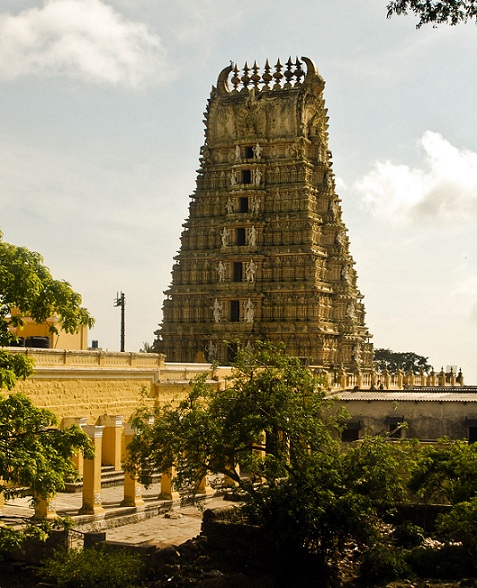
- Chamundeshwari Temple, Mysore (Image: Wikipedia)
Thus, the festival brings together two narratives of victory:
the sacred victory of the Goddess over Mahishasura, and the historical royal tradition of the ruler leading his kingdom into a new ceremonial year. That combination of mythology, kingship and public celebration is one of the defining characteristics of Mysuru Dasara.
Before Mysuru, there was Vijayanagara
Long before the illuminated Mysore Palace became the familiar image of the festival, Mahanavami was celebrated with extraordinary grandeur in the Vijayanagara Empire.
The accounts of travellers who visited Vijayanagara offer glimpses of a spectacular royal world. Niccolò de' Conti, Abdur Razzaq, Domingo Paes and Fernao Nuniz described ceremonies in which religion, kingship, military power and public spectacle came together.
The Mahanavami celebrations were not merely religious observances. They provided an occasion for the sovereign to display authority, for feudatories and chiefs to demonstrate allegiance, and for the empire to present its wealth and military strength.
Domingo Paes, who witnessed the celebrations during the reign of Krishnadevaraya, was overwhelmed by what he saw. His account describes a spectacle so immense that he struggled to take it all in while watching the royal and military procession.
Centuries later, traces of that world would survive in Mysuru.
The festival's history is a story of traditions travelling, changing and acquiring new meanings as political centres changed.
Historical accounts trace the grandeur of Dasara to the Vijayanagara tradition, while later Wadiyar rulers of Mysuru adapted and expanded it within their own kingdom.
The Wadiyars and the making of a royal tradition
In 1610, Raja Wadiyar I revived the Dasara tradition on a grand scale at Srirangapatna, then the capital of the Wadiyar kingdom. This moment is central to the written history of Mysuru Dasara.
The Wadiyars had been connected to the political world created by Vijayanagara. As that empire declined, the Wadiyars rose to greater prominence in the Mysore region. Raja Wadiyar transformed Dasara into an important royal festival, giving it a distinctly Wadiyar character while retaining the grandeur associated with the earlier Vijayanagara tradition.
The celebrations included elaborate rituals, royal ceremonies and displays of power.
The festival was not confined to the palace. The city itself became part of the celebration.
Artists, craftsmen and workers were involved in preparing the city. Visitors, travellers, chiefs and representatives from different sections of society gathered for the festivities. Royal durbars, music, wrestling and ceremonial processions became part of the evolving Dasara tradition.
In this sense, Dasara was already becoming more than a religious festival. It was becoming a theatre of the kingdom.
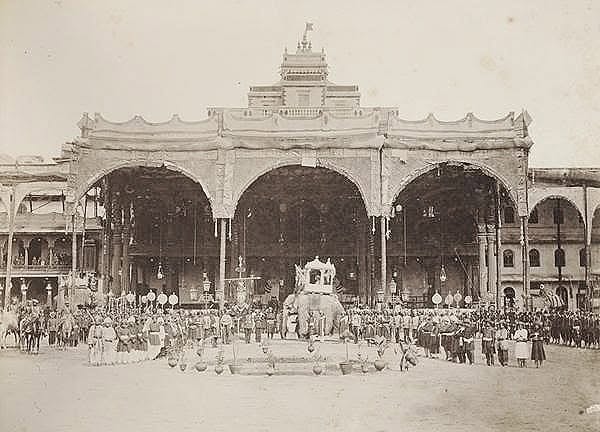
- Dasara procession in the Old Wooden Mysore palace in 1870s (Image: Oldbangalore)
The rulers who followed Raja Wadiyar continued to shape the festival.
Under Chikkadevaraja Wadiyar, elements associated with royal and military authority became prominent. These were military insignias associated with the royal procession, and traditions connected with them continued to appear in later Dasara celebrations. The royal sword, weapons, elephants, horses and ceremonial insignia all became part of the visual language of Dasara.
This is one reason why Mysuru Dasara has always felt different from a festival that exists only within a temple. Here, kingship itself became part of the ritual.
After the fall of Tipu Sultan in 1799, the Wadiyar dynasty returned to political prominence. Krishnaraja Wadiyar III assumed responsibility for the kingdom, and the capital was shifted from Srirangapatna to Mysuru.
Dasara followed the capital. From then onwards, Mysuru increasingly became the stage upon which the festival would develop into the spectacular celebration that visitors recognise today.
The nineteenth and early twentieth centuries brought further changes.
Royal durbars became important occasions. European visitors were invited. Processions became carefully organised spectacles. Music, military displays, wrestling and ceremonial performances found their place within the festival.
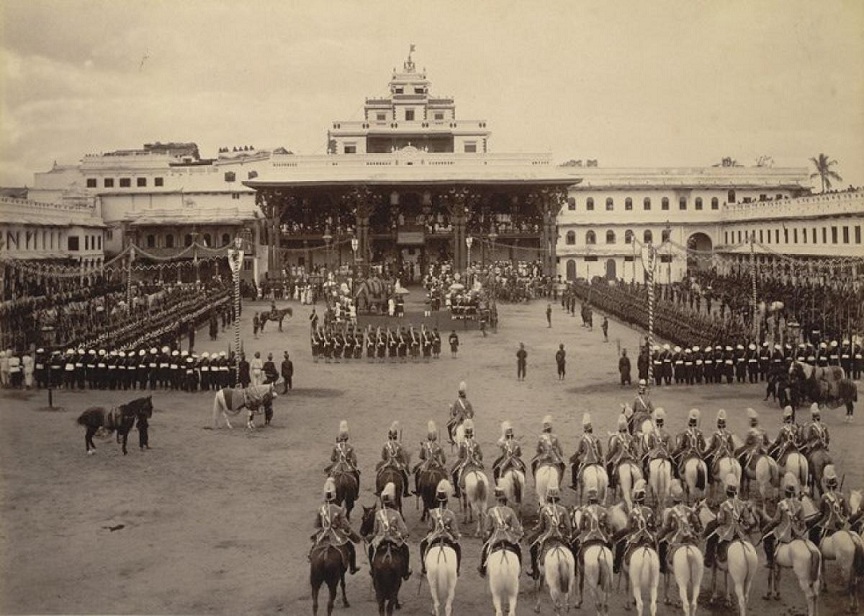
- Dasara procession in the Old Wooden Mysore palace (Image: Deccan Herald)
The celebration was simultaneously looking backwards and forwards—preserving royal traditions while incorporating the changing world around the Mysore court. Historical accounts record, for example, the introduction of a Dasara Durbar for Europeans under Krishnaraja Wadiyar III and later changes under Chamaraja Wadiyar X.
A festival enters the modern city
By the time of Nalwadi Krishnaraja Wadiyar IV, Dasara had reached another important stage. The Maharaja's reign from 1902 to 1940 coincided with an era in which Mysuru was being presented as a modern and prosperous princely state.
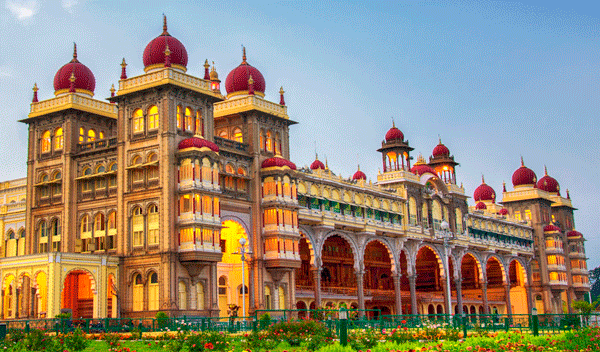
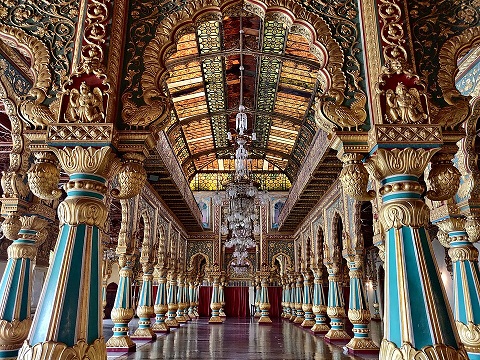
- Mysuru Palace (Image: Wikipedia)
Dasara became one of the great occasions through which that image was communicated.
The royal Durbar, cultural performances, wrestling, music, ceremonial displays and the growing Dasara Exhibition all contributed to this transformation.
The exhibition, in particular, connected the festival with the economic and industrial aspirations of the state. What had once been primarily a royal and religious spectacle increasingly became a place where agriculture, industry, craftsmanship, commerce and modern technology could also be displayed.
The festival was becoming a window through which Mysuru presented itself to the wider world.
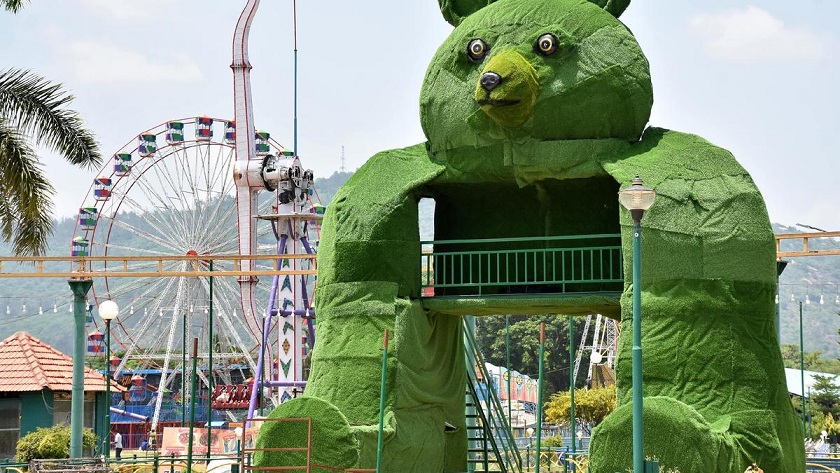
- Dasara Exhibition (Image: The Hindu)
The 1935 edition of C. Hayavadana Rao's book 'The Dasara in Mysore: Its Origin and Significance' states that it sought to explain not only the royal pageantry associated with Dasara but also its religious and social significance and the historical developments through which the festival had evolved.
From royal Dasara to Nada Habba - The State Festival of Karnataka
Perhaps the most fascinating chapter in the story of Mysuru Dasara is what happened after the end of princely rule.
Following the abolition of princely privileges and the decline of the royal Durbar tradition, public Dasara celebrations entered a new phase. The Karnataka state government eventually took a larger role, and Dasara emerged as Nada Habba—the state festival of Karnataka.
Historical accounts describe the transformation from a primarily royal celebration into a wider public festival during the 1970s.
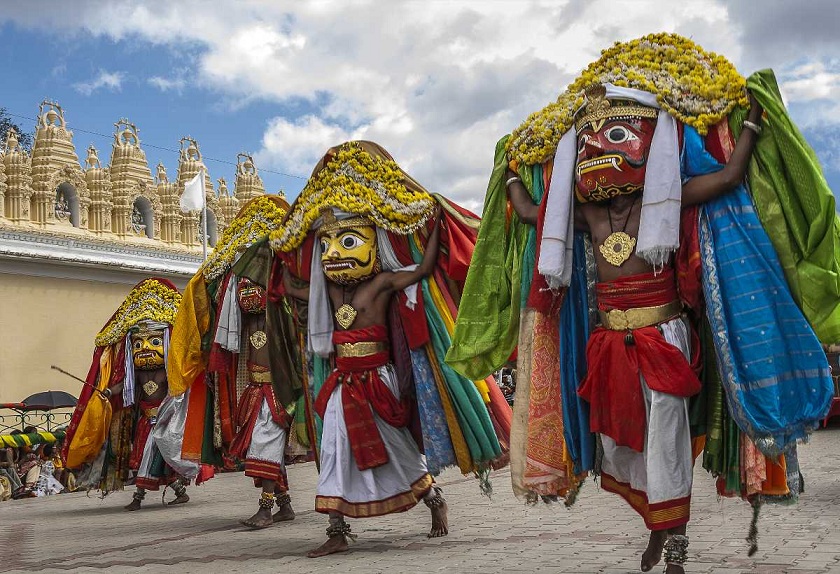
- From Dasara Procession (Image: Tusktravel)
That transition changed the meaning of the festival. Once, the procession represented the power of a king. Today, the festival belongs to a much larger public.
The city begins to glow
If you arrive in Mysuru during Dasara, the first thing you may notice is not the procession. It is the light.
As evening approaches, the city begins to change.
Heritage buildings are illuminated. Streets become brighter. The palace, already magnificent by day, becomes almost theatrical at night.
- Illuminated Mysore Palce and its surroundings (Image: savaari.com)
For a moment, it becomes easy to imagine how the city must have appeared to visitors arriving for the royal Dasara generations ago—not identical, of course, but carrying the same sense that something important was happening.
Today, the celebration extends well beyond the palace.
Music and dance programmes, food festivals, sporting events, exhibitions, yoga programmes and other cultural activities take place across the city.
It is an entire city in festival mode.
Experience Mysuru Dasara this year with City Heritage
From 11 October, Mysuru comes alive with the colours, sounds and traditions of Dasara. The celebrations begin at Chamundi Hill and continue across the city with cultural programmes, music, dance, exhibitions and public events, while the palace and heritage landmarks glow after sunset. On 21 October, the festivities reach their grand finale with the historic Jamboo Savari and the spectacular torchlight parade at Bannimantap.
Experience Mysuru beyond its illuminated palace and festive crowds. Walk through its historic streets, palaces, markets and cultural spaces, and discover the stories of the Wadiyars and the traditions that have shaped this remarkable celebration.
With City Heritage, experience Dasara not simply as a festival to watch, but as a living heritage tradition to explore, understand and remember.
This year, come walk through the history, culture and living traditions of Mysuru—and experience a city telling its story once again.
References
The History of Dasara — Deccan Herald
https://www.deccanherald.com/india/karnataka/the-history-of-dasara-2712545
Mysuru Dasara: A Blend of History, Culture, and Tradition — The Hindu
https://www.thehindu.com/news/national/karnataka/mysuru-dasara-a-blend-of-history-culture-and-tradition/article67420303.ece#google_vignette
Mysore Dasara Festival Celebration 2026 – A Complete Guide — Tusk Travel
https://www.tusktravel.com/blog/mysore-dasara-festival-celebration/
Mysore Dasara, a Royal Festival Celebrating Victory of Truth over Evil — Mysore Dasara
https://www.mysoredasara.org/about-mysore-dasara.html
The Dasara in Mysore: Its Origin and Significance — Book, published in 1935
https://archive.org/details/in.ernet.dli.2015.48127
Mysore Dasara: The Dark Legend Behind India’s Grandest Dussehra Celebrations — GQ India
Come to Mysuru this Dasara.
Experience Mysuru Dasara with City Heritage — walk through its history, discover its living traditions, and see the city come alive in celebration.
Visit us and Contact:
Visit: www.cityheritage.in
Email: mail@cityheritage.in
Instagram: cityheritage.in
Phone: +91 7356569573, +91 8377024979




 (1).png)
© Copyright 2026 City Heritage. All rights reserved.
Website designed by TNM Online Solutions.
If you have any enquiry, feel free to ask, and we'll provide you with a prompt and concise response.