
Yasin Asharaf P | Published on 13/12/2025
Echoes of the Raj: Tracing British Footprints
The shores of the Arabian Sea were in a rare peace, barely awake in the soft, 7 AM glow. At Bhatt Road Beach, the morning walkers enjoyed the solitude, perhaps unaware they trod the same sands where, long ago, British officers indulged in their own leisure and this very shore was once a private leisure spot. The low whistle of a train horn, marked our official departure from the coast and into the colonial past. We waited at the railway crossing for the gates to open so we could cross the road and reach the meeting point.
The team, gathered for ARPO’s Heritage Fest, met at Chungam Junction—a name that whispers of its history, for Chungam literally means 'tax,' collected right at this spot in a bygone era. From here, we began a journey into the heart of Malabar's British past, tracing the path of power from the West Hill to the East Hill of Kozhikode.
West Hill: The Echoes of Power and Rebellion
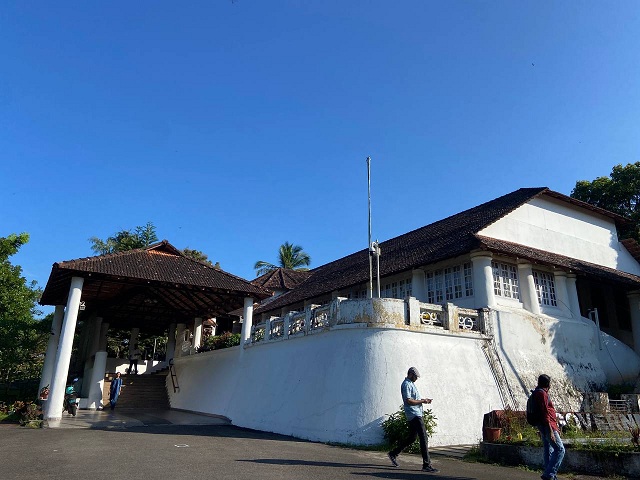
The first leg of our walk led us up a gentle incline to West Hill. After navigating a couple of winding curves, we arrived at the site of the current Indian Military Barracks (122 Infantry Battalion (Territorial Army)), which stands sentinel where the formidable British Military Barracks of the Malabar District once commanded the landscape. Directly across the road, a grand, yet melancholic vision came into view: the West Hill British Bungalow. With its imposing pillars and blend of British and Kerala architecture, this building holds the pride and the trauma of colonial power, for this was the first seat of the Malabar Collectorate under the Madras Presidency. It’s here we must pause and consider the term ‘Collector.’ Before Independence, this figure was simply the 'tax collector.' Yet, after 1800, these Indian Civil Service officers—starting with Major William Macleod—came to govern a massive territory, handling everything from revenue to law and order.
The Ghost of Conolly
But the West Hill Bungalow is perhaps most famous for its darkest hour: the brutal assassination of Collector H.V. Conolly. Imagine the horror. The freedom struggle had intensified, and in a mysterious, violent act, two men brought Conolly’s life to a bloody end right here. His body was initially interred near the Kozhikode Beach, but his presence, it is said, lingered. The subsequent Collector was so disturbed by the whispers—the 'ghost’s whispers' of Conolly, as he complained to the Madras Presidency—that he refused to stay. And so, the Collectorate moved to East Hill.. Yet, Conolly’s impact remains unstained across Kozhikode. The popular Conolly Canal and the magnificent Nilambur Conolly’s Teak Plot are enduring monuments to his vision. He even transformed the city's main market, Valiyangadi, by offering a subsidy to replace flammable palm-leaf roofs with tiles—a legacy visible in every corner of the old town.
A Secret Society on the Path East
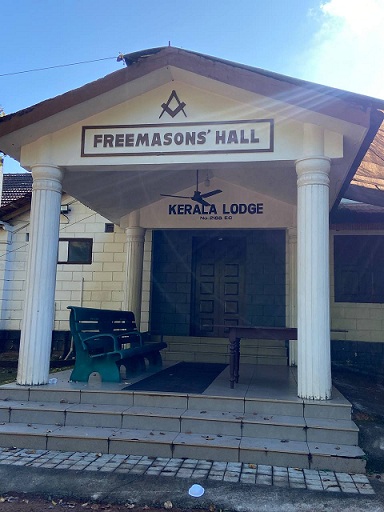
Leaving the haunted history of West Hill, we followed the administrative shift to the east. Along the way, we encountered a building that added a touch of intrigue to our historical exploration: the Freemasons Hall. Built in 1893 and known as the ‘Masonic Temple’ or Kerala Lodge, its wall still bears the distinct Square and Compasses symbol. This is a fraternal group that trace their origins to medieval guilds of stonemasons. Freemasonry is considered the oldest existing secular fraternal organisation, with documents and traditions dating back to the 14th century, It stands as a silent witness to the various communities and fraternal groups that flourished even in the late 19th-century Malabar.
The Seat of Later Power: East Hill
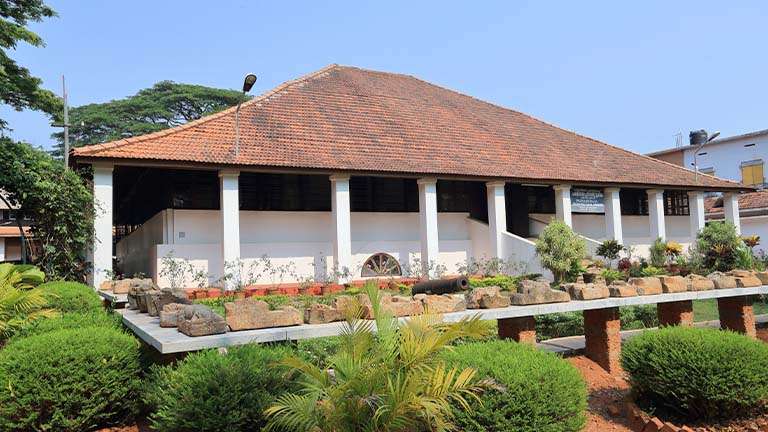
The journey culminated at the East Hill British Bungalow, the final, powerful seat of the Malabar Collectorate. The walk was invigorating, the fatigue of the 2 km journey soon forgotten amidst the calming, natural atmosphere of the East Hill. Now repurposed as an Archaeological Museum, this magnificent structure offers a window into Malabar's history, from prehistory to the modern era. This building was the ultimate centre of colonial authority, serving as the Governance Centre, a Court, and its bottom floor as a jail. Local lore even suggests a tiger was housed nearby to act as a terrifying guard for the jail inmates! It was within these calming, nature-filled yards that history and literature converged. William Logan worked here, compiling the essential Malabar Manual, and later, the famous Malayalam writer Malayattur Ramakrishnan penned his novel, Yanthrangal (Machines), a chronicle of civil service life. As our walk ended, we reflected on the profound transformation wrought by the colonial era. British rule was a double-edged sword: it brought the necessary progress of the railway, the canal, modern schools, and factories. But it also brought the dark legacy of oppression, the killing of freedom fighters, and tragic events like the Wagon Massacre. Today, the very fabric of Kozhikode—the roads we drive, the terms we use, the infrastructure that supports our lives—bears the indelible mark of the Raj. The heritage walk was not just a look at old buildings, but an understanding of how the past continues to shape the present Malabar, one hill, one bungalow, one compelling story at a time.
Visit us and contact:
Explore the fascinating history of the British Raj in Kozhikode. Contact us for an unforgettable heritage walk through West Hill and East Hill.
Get in Touch:
Visit: www.cityheritage.in
Email: mail@cityheritage.in
Instagram: cityheritage.in
Phone: +91 7356569573, +91 8377024979
(*Image courtesy: Kerala Tourism)




 (1).png)
© Copyright 2026 City Heritage. All rights reserved.
Website designed by TNM Online Solutions.
If you have any enquiry, feel free to ask, and we'll provide you with a prompt and concise response.