
Yasin Asharaf P | Published on 13/12/2025
The North Malabar region of Kerala, including the districts of Kasaragod, Kannur, and certain areas of Kozhikode are alive with Theyyam performances from mid-October until the end of May or early June. Theyyam is more than just a dance performance; it is a sacred ritual where the performer transforms into a divine embodiment. Each Theyyam has its own stories that resonate deeply with the local people. Various classifications of Theyyam exist, including male Theyyams, female Theyyams, Mappila Theyyam, War Theyyam, and Heroic Theyyam, and others.
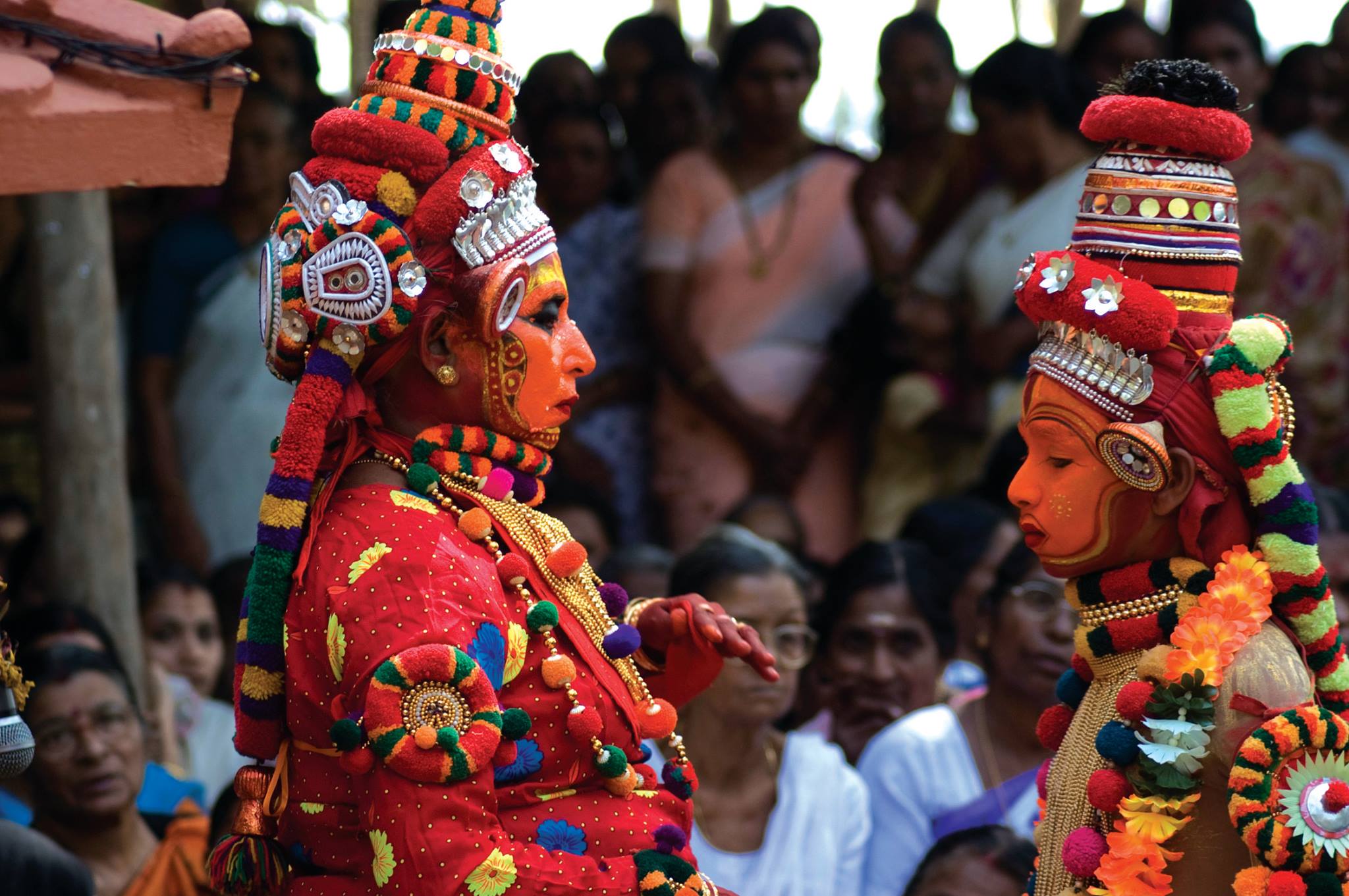
Generally, male performers portray the female deities including Muchilottu Bagavathi, Kadaangottu Maakkam, Thottinkara Bagavathi, Chooliyar Bagavathi, Puthiya Bagavathi, and others. The notable exception is Devakoothu Theyyam, which is performed by a woman. This particular performance (Kaliyattam) is held at the Koolom Thazhekkavu Bhagavathy Temple on the island of Thekkumbad, near Cherukunnu in Kannur.
Until 2019, the Devakoothu Theyyam performance was held biennially (once every two years). However, all performances were halted during the Covid-19 pandemic. When the rituals resumed in 2022, the committee of the Koolom Thazhekkavu Bhagavathy Temple decided to make the performance annual. Thus, Devakoothu has been held as an annual event since 2022.
Theyyam is generally performed by nine major marginalized communities such as Vannan, Malayan, Velan, and Mavilan, who are classified as Scheduled Caste and Scheduled Tribe in the state. Devakoothu is specifically performed by the Malayan community. In the context of Kerala, where practices like untouchability, unapproachability, and even unseeability were prevalent, Theyyam rituals have historically served as a form of resistance.
The vibrant ritualistic art form of Theyyam traces its deep roots to the ancient Dravidian culture of South India, forming an essential part of the ancient tribal culture of Kerala, where it evolved from tribal animism—the region's most common early form of worship. Theyyam rituals incorporate the worship of trees, plants, and animals alongside Hindu gods, sometimes involving dangerous feats like blood sacrifices and fire walking. Known also as ‘Kaliyattam’ (due to its worship of the goddess Kali) and ‘Thirayattam’ (as every thira, or village, performs it at the local kaavu, or temple), Theyyam is a perfect blend of dance, music, and mime.
Women in Performance:
Historically, Kerala's deeply patriarchal society limited the performing arts almost exclusively to male performers. Out of more than 400 distinct Theyyams, Devakoothu remains the sole Theyyam enacted by a woman. Furthermore, the compounded challenges of caste oppression and entrenched patriarchy made it extremely difficult for lower-caste women to rise as Theyyam performers.
The Mythical Story behind the Devakooth Theyyam:
One day, a group of goddesses looked down from their heavenly home. Below, on Earth, they saw a beautiful sight. It was a forest, tangled with thick vines, where stunning flowers bloomed, filling the air with a mesmerizing fragrance. This magical place was the island of Thekkumbad. They couldn’t resist, so they left their world and went down to pick the flowers. Happy and enchanted, they wandered through that forest, gathering blossoms.
But as they moved through the vines, one of the goddesses became trapped. The others didn’t notice she was missing right away. When they finally realized she was gone, they searched everywhere, calling for her, but they couldn’t find her anywhere. As sunset approached, they had no choice but to return to the world of the gods, their hearts heavy with sadness and worry.
Meanwhile, the lost goddess struggled, tangled in the vines, unsure of what to do. Just then, a kind king arrived there. He gently freed her from the vines and, wanting to keep her safe, placed her in a small hut nearby. Soon after, Narada Maharshi—a wise sage who had come searching for the missing goddess—found her in the hut. He safely brought her back to the world of the gods, reuniting her with her worried sisters.
This touching story evolved into a legend, and a temple was later erected in its honor. To this day, the tale is brought to life through graceful DevakoothTheyyam performance, carried out with deep devotion and profound spiritual meaning.
The Rituals before the Performance:
Women who have ceased menstruating earn the right to wear the Theyyam Vesham(Role). After a strict 41-day fast as prescribed in the scripture Pallimala—during which they abstain from fish and meat and devote themselves to prayer in a pooja room—they proceed to the temple to adorn the Theyyakkolam.
The Theyyam performance occurs on the fifth day of Dhanu (Malayalam month), but she and the women who are accompanying her begin their journey from home on the third. They travel to Valluvan Kadavu carrying the Pallimala scripture and a plate filled with rice and flowers. Temple officials await them at the Kadavu with a raft—two boats tied together and planked. They make their way to the ancestral home of the Valluvan Kuruppans, where they are welcomed with a full plate and flowers scattered upon the bank. At night, accompanied by Thalapoli and music, they are escorted to the temple.
Inside the temple, there is a shelter called a coochil which was already prepared. The women stayed there in its dedicated pooja room, praying until the day of Devakoothu. On the fifth of Dhanu, they rise early. After completing their spiritual rituals, they begin Mukhamezhuthu— the painting of the theyyam’s face. A unique feature of this makeup is its use of natural pigments to craft intricate expressions. The palette, derived from the earth, relies mainly on vivid reds, deep blacks, bright yellows, and pure whites.
Adorned in traditional ornaments, the performer wears a magnificent turban crowned with twenty-one stones—a symbol of power and divinity—over a ceremonial cap. Every movement is marked by the silvery chime of ghungroo (ankle bells) and padasaram on their feet.
They approach the temple before noon, passing through a cloth curtain held by two women. By then, devotees are already waiting in eager anticipation. With the stage set, the Devakoothu begins as they step forward with firm, solemn steps.
Theyyam Performance (The Kaaliyattam)
When the time for the ritual comes, the performer prepares to receive the goddess. The transformation is striking, following all the ancient rites for a Theyyam. As the divine energy fills the arena, the performance begins.
Invocation: The very first act is an offering of praise. With a rhythmic chant, the performer sings songs in devotion to Lord Ganesha, the remover of obstacles, setting the stage for the sacred events to unfold.
The Divine Dance: Then, the movements begin—a dance of grace and power, guided by a rhythmic song. Step by step, the entire mythical saga of Valliymma is revealed. The devotees watch captivated as the story of the goddess unfolds: her joyful life, the carefree moments of picking flowers in the garden with her friends, and the pivotal moment when she mysteriously disappeared, lost amidst the very creepers that gave her name.
The Arrival of Narada: At the climax of the performance, a new character bursts into the arena—the celestial sage, Narada, appearing in fresh, vibrant attire. His arrival signals a turning point in the divine tale.
Devakkoothu is a demanding ritual that uses spoken parts. Chanting, singing, and reciting are all important spoken parts that help set the mood, make people feel emotions, and keep the audience interested. The song is set up so that the Apsara (celestial dancer) asks her friends if they can pick flowers from the garden: “chethi malaro thottathilellam, chethi malaro koyyavo thozhi”(Are there Ixora flowers all over the garden? Can we pick them, friend?). Also, the dancers' physical movements and visual gestures show that this spoken tradition is expressed through the body. This emphasizes how music, movement, and words work together to create the Devakkoothu experience.
The Devakkoothu performance ends when the Apsara (celestial dancer) performs with Narada, who came to Earth to take her back to heaven. When the story is complete and the goddess's blessing has been bestowed, the sacred ritual concludes. As a final act of grace, cooked rice, sanctified by the presence of the goddess, is distributed to all the assembled faithful as Prasada, ensuring the devotees carry a piece of the divine protection with them.
The local people deeply respect the god, Valliyamma, and have high hopes. They strongly believe that if they please her, she will give them many blessings, such as money, good health, and joy. They also believe that Valliyamma can cure illnesses and diseases in the community. The way the goddess is shown in Devakkoothu makes her look like a very womanly, caring, and detailed figure whose main goal is to encourage love and kindness among everyone.
Continuing Legacy:
The Devakooth Theyyam is currently performed by M.V. Ambujakshi of Pazhyangadi. A post office employee, she learned the art from her husband, the prominent artist Kattuparambath Kannan Panikkar. She assumed this unique role after the previous performer, Lakshmi Amma, could no longer wear the costume due to ill health and passed the right to her relative, Ambujakshi. Though Narada has a major role in the entire narrative, he appears only for a few minutes in the performance and was portrayed by a young boy in the same family. The decision to conduct the Devakooth theyyam annually depends on the situation of the family and the organizers. If a family member dies, the performance will be cancelled.
The annual Devakoothu Theyyam performance on Thekkumbad island draws thousands to the temple, creating a spiritual atmosphere. This event uniquely brings together a diverse audience, including local devotees, researchers, anthropologists, media, photographers, and a large number of foreign visitors.
Visit us and contact:
For an unforgettable Theyyam tour experience, also the Devakooth and a range of other authentic ritual performances with city Heritage.
Get in Touch:
Visit: www.cityheritage.in
Email: mail@cityheritage.in
Instagram: cityheritage.in
Phone: +91 7356569573, +91 8377024979
(*Image courtesy: Kerala Tourism)




 (1).png)
© Copyright 2026 City Heritage. All rights reserved.
Website designed by TNM Online Solutions.
If you have any enquiry, feel free to ask, and we'll provide you with a prompt and concise response.