
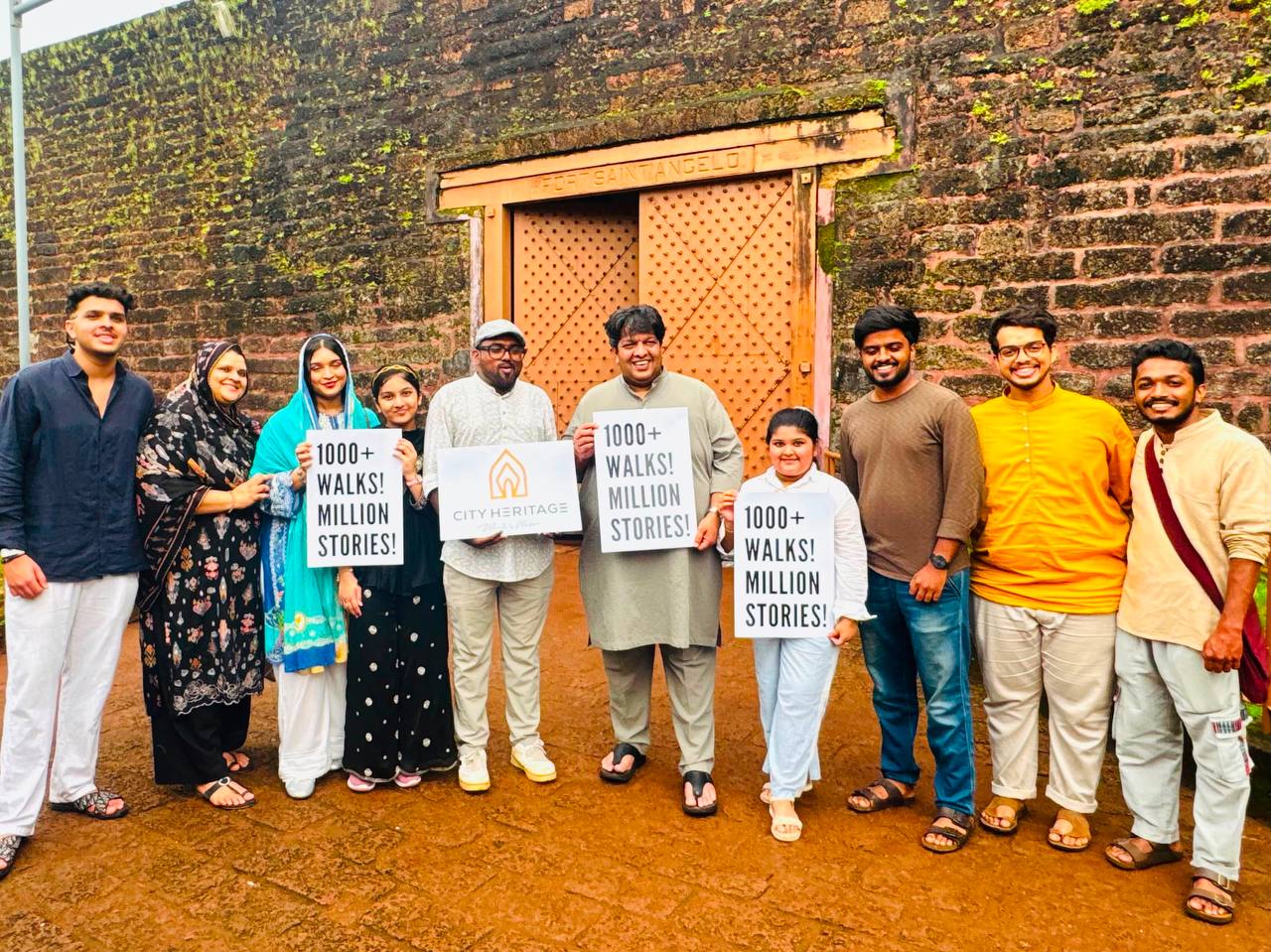
City Heritage has achieved a remarkable milestone by completing 1,000 heritage walks, marking a significant chapter in the organisation’s journey of documenting, interpreting and sharing the cultural heritage of Malabar.
City Heritage began its heritage walk programme in September 2018. Over the past eight years, the initiative has continued despite numerous challenges and limitations, establishing itself as a distinctive platform in the field of heritage, cultural tourism and experiential learning. During this journey, City Heritage has also received recognition at both national and international levels for its work in promoting heritage and cultural experiences.
The landmark 1,000th heritage walk was conducted specially for Muhammed Madani, prominent Kannur-based entrepreneur and Chairman of the ABC Group, along with his wife and children, making the occasion particularly meaningful for City Heritage.
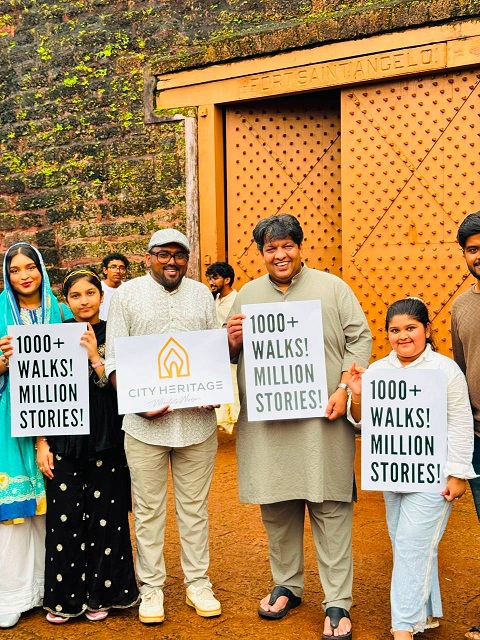
- Celebrating 1,000+ Heritage Walks of City Heritage with Muhammed Madani, prominent Kannur-based entrepreneur and Chairman of the ABC Group
Speaking on the occasion, Muhammed Madani said that he felt proud to be part of a heritage experience that celebrates and presents the history and cultural richness of Kannur to the world. He congratulated City Heritage on reaching the milestone and extended his best wishes for its continued journey.
“As someone from Kannur, I feel extremely proud to be part of an initiative that brings the heritage and unique identity of our city to a wider audience. I extend my heartfelt wishes to City Heritage as it reaches this remarkable milestone,” Madani said.
Reflecting on the achievement, Muhammed Shihad, Founder of City Heritage, expressed his gratitude to everyone who had supported the initiative from its early days.
“On this special occasion, we remember with gratitude everyone who stood with us from our very first heritage walk. Reaching 1,000 sessions is not merely a number; it represents years of commitment, learning, storytelling and the collective support of people who believed in the importance of preserving and sharing our heritage,” Shihad said.
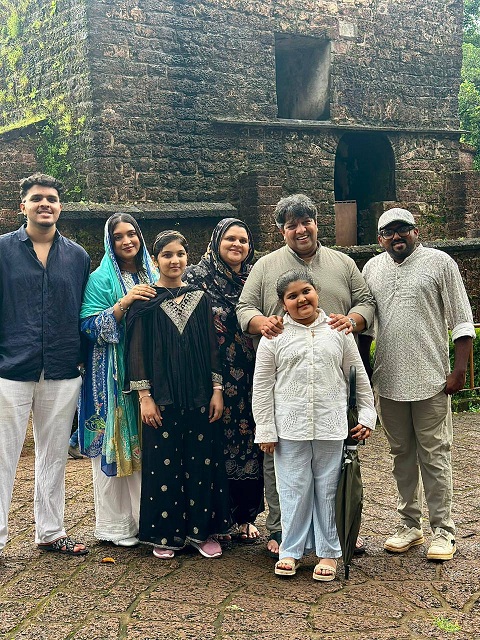
- City Heritage Founder Muhammed Shihad with the family of Muhammed Madani during the heritage walk.
What began in Kannur has gradually expanded across Malabar and North Kerala, creating heritage and cultural experiences that connect visitors with the region’s history, architecture, food, traditions, art and living culture.
The heritage walks have brought together a diverse range of participants, including students, researchers, travellers, academics, cultural enthusiasts and policymakers. Visitors from 16 countries have also participated in different City Heritage experiences, making the initiative an important platform for presenting the heritage of Kannur and Malabar to an international audience.
The 1,000th heritage walk was attended by Muhammed Madani, Sharmina Muhammed Madani, and their children Ziya Fathima, Nashish Muhammed and Saha Fathima, along with Ayisha Marshad, Shabeer T., Mustafa K. and Muhammed Sharafudheen. Members of the City Heritage team, including Yasin, Ambili, Ranjith, Haseeb and Tasneem, were also part of the landmark session.
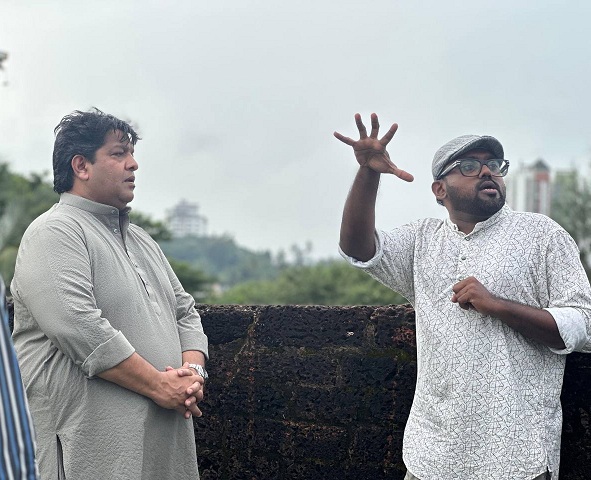
- During the heritage walk.
Over the years, City Heritage has independently organised and collaborated with various institutions to conduct a wide range of programmes exploring the art, heritage, culture, cuisine, history and architecture of Kannur and the wider Malabar region. Its programmes have sought to move beyond conventional tourism by creating immersive experiences that allow participants to understand heritage through stories, places, people, traditions and lived cultural practices.
'WHEELS TO WISDOM': The Journey of City Heritage:
City Heritage began in 2014 with a simple yet profound question: What happens when communities begin to forget their own stories? That question became the beginning of a journey rooted in a belief that heritage cannot survive in archives alone. It must be experienced, shared, and kept alive by the people who inherit it.
The first revival came through food. In 2016, City Heritage turned towards the kitchens of Malabar, recognising that recipes were more than instructions for preparing a meal—they were vessels of memory. Traditional Mappila cuisine carried within it stories of maritime trade, migration, faith and generations of cultural exchange. By sitting with home cooks, elders and traditional practitioners, City Heritage began recording recipes, techniques, seasonal customs and the memories preserved within family kitchens. Soon, the kitchen itself became a place of storytelling. Guests were welcomed into traditional homes not simply as visitors, but as family. Around the dining table, food became history, hospitality became interpretation, and every meal became a journey through the living culture of Malabar.
Then, in 2018, the journey found its feet—literally. The streets became classrooms. Beginning as the Kannur City Heritage Foundation, the team introduced storytelling heritage walks, inviting people not merely to read history, but to step into it—to walk through its streets, encounter its forgotten stories, and experience the living heritage of Kannur. Historic streets, ports, markets, places of worship and neighbourhoods became living classrooms. A wall could reveal a forgotten trade. A street could speak of migration. A mosque could open a window into centuries of cultural exchange. A fort could become the starting point for stories of power, conflict and the sea. Research was no longer confined to books and archives; it walked alongside people. Students, researchers, travellers and local communities began discovering that history was not distant—it was beneath their feet.
Since 2018, more than 1,000 storytelling heritage experiences have connected thousands of people with the living heritage of Malabar, including participants from more than 16 countries. Each journey carried a different story, but together they created a larger narrative: that heritage is not simply inherited—it must be experienced. From Kannur's Arakkal legacy and Theyyam to Thalassery's colonial encounters; from Kozhikode's Arab maritime heritage and historic Kuttichira to Beypore's legendary Uru shipyards, City Heritage began to see Malabar not as a collection of destinations, but as one interconnected cultural landscape.
But somewhere along the way, the journey became about more than places. It became about people. The artisan, the fisherman, the traditional cook, the Theyyam artist, the Uru craftsman, the plantation worker, the religious scholar, the local historian and the community elder became co-curators of the story. Their memories and skills revealed dimensions of heritage that no archive could fully contain. City Heritage learned that the most valuable heritage experts are often those who continue to live the traditions every day.
The journey also moved into classrooms—but not the classrooms of four walls. Universities, schools and professional institutions became partners in turning Malabar into an open classroom. Through cultural immersion programmes, storytelling walks, architectural documentation, workshops and public-history sessions, students encountered history through landscapes, buildings, industries, foodways, sacred spaces and communities. Collaborations with institutions such as IIM Kozhikode, NIFT, Kannur University and others created bridges between academic knowledge and lived culture.
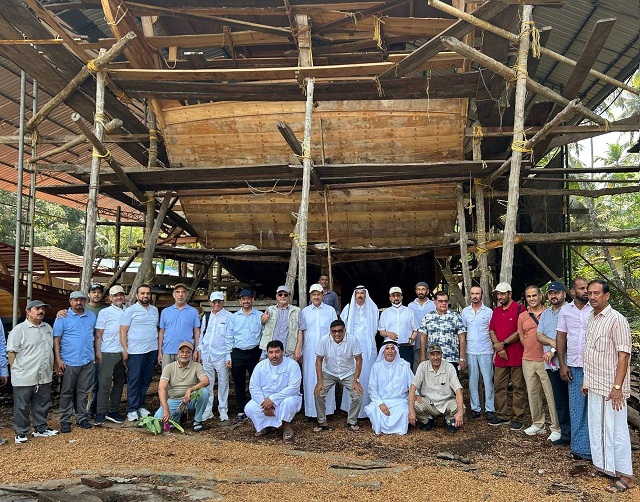
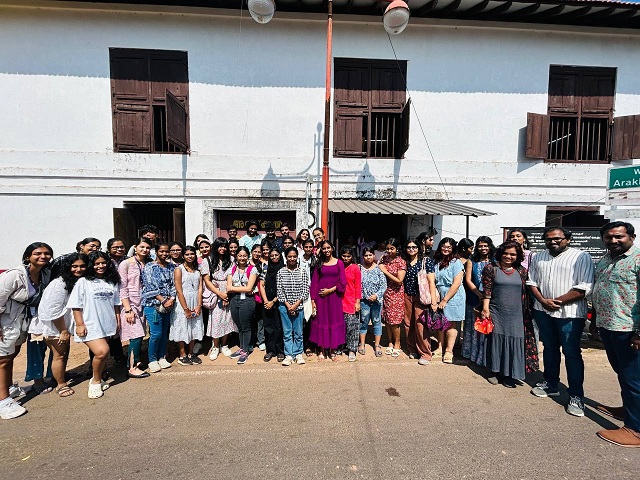
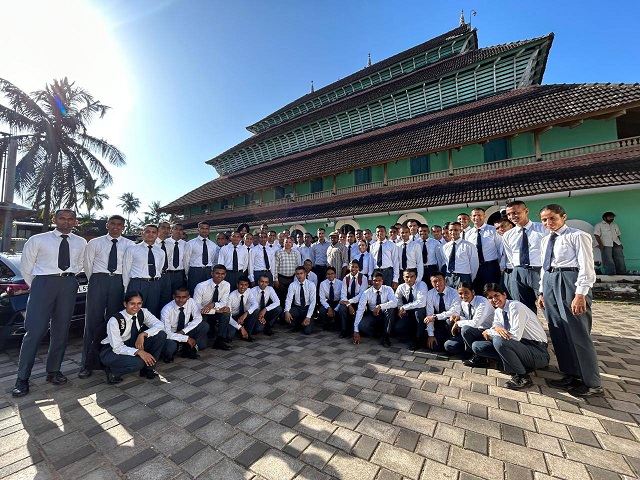
- City Heritage’s Heritage Storytelling Walks Across Malabar
The sea, too, began to speak. Since 2022, City Heritage has shared stories of Malabar's maritime world with cadets of the Indian Naval Academy at Ezhimala. The stories travelled through Uru shipbuilding, maritime trade, naval conflicts, the Arakkal Kingdom, European expansion and coastal settlements, bringing figures such as Baliya Hassan, Kunjali Marakkar and the Zamorin of Calicut into a wider understanding of India's maritime history.
Yet telling stories also meant asking difficult questions. Heritage could not be treated merely as something to consume. Through exhibitions and public conversations—including the exhibition at the Veru Festival in Fort Kochi exploring the changing relationship between Theyyam, photography, tourism, technology and cultural ethics—City Heritage began creating spaces where heritage could be questioned as well as celebrated.
And when historic places needed a voice, City Heritage stepped beyond interpretation into advocacy. The legacy of the Arakkal Royal Dynasty became one such cause, with sustained attention given to the conservation, interpretation and public understanding of its extraordinary heritage. The 500th commemoration of Shaheed Valiya Hassan became another moment of public remembrance, bringing historians, researchers, students, cultural practitioners and communities together to revisit a significant chapter of Malabar's resistance and maritime history.
Over time, the footsteps became a network. Research connected with education. Education strengthened conservation. Conservation enriched tourism. Tourism created opportunities for communities. Partnerships multiplied, linking City Heritage with universities, tourism organisations, government bodies, professional institutions and cultural networks. Recognition followed—not as the destination, but as a reflection of the work. In 2025, City Heritage received the Silver Award in Urban Heritage & Cultural Immersion at the Outlook Responsible Tourism Awards, recognising its approach to experiential heritage interpretation and responsible tourism.
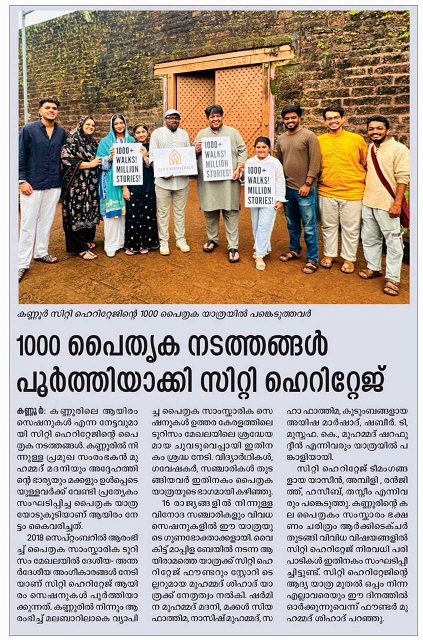
- Madhyamam News Report on the Celebration of 1000 Heritage Walks of City Heritage
What started in North Kerala as an attempt to document disappearing heritage has grown into a wider movement. The next chapter reaches towards an eleven-city vision, connecting places including Delhi, Mumbai, Kolkata, Hyderabad, Bengaluru, Srinagar, Kanyakumari, Panaji, Calicut, Kochi and Kannur, while keeping local knowledge at the centre. But the destination is still not the point. There are countless stories still waiting to be documented. Traditions still waiting to be recognised. Communities whose knowledge deserves to be heard. Places whose value must be understood before they disappear.
The completion of 1,000 heritage walks marks both a celebration of the journey so far and a renewed commitment to documenting, preserving and sharing the cultural heritage of Kannur and Malabar with future generations and audiences around the world.




 (1).png)
© Copyright 2026 City Heritage. All rights reserved.
Website designed by TNM Online Solutions.
If you have any enquiry, feel free to ask, and we'll provide you with a prompt and concise response.